















Ophthalmoscope and Otoscope Sets: Wall-Mounted vs Portable, and How to Choose One
Wall-mounted vs portable ophthalmoscope otoscope sets: power, LED vs halogen heads, lens range, specula and which set fits each exam room.
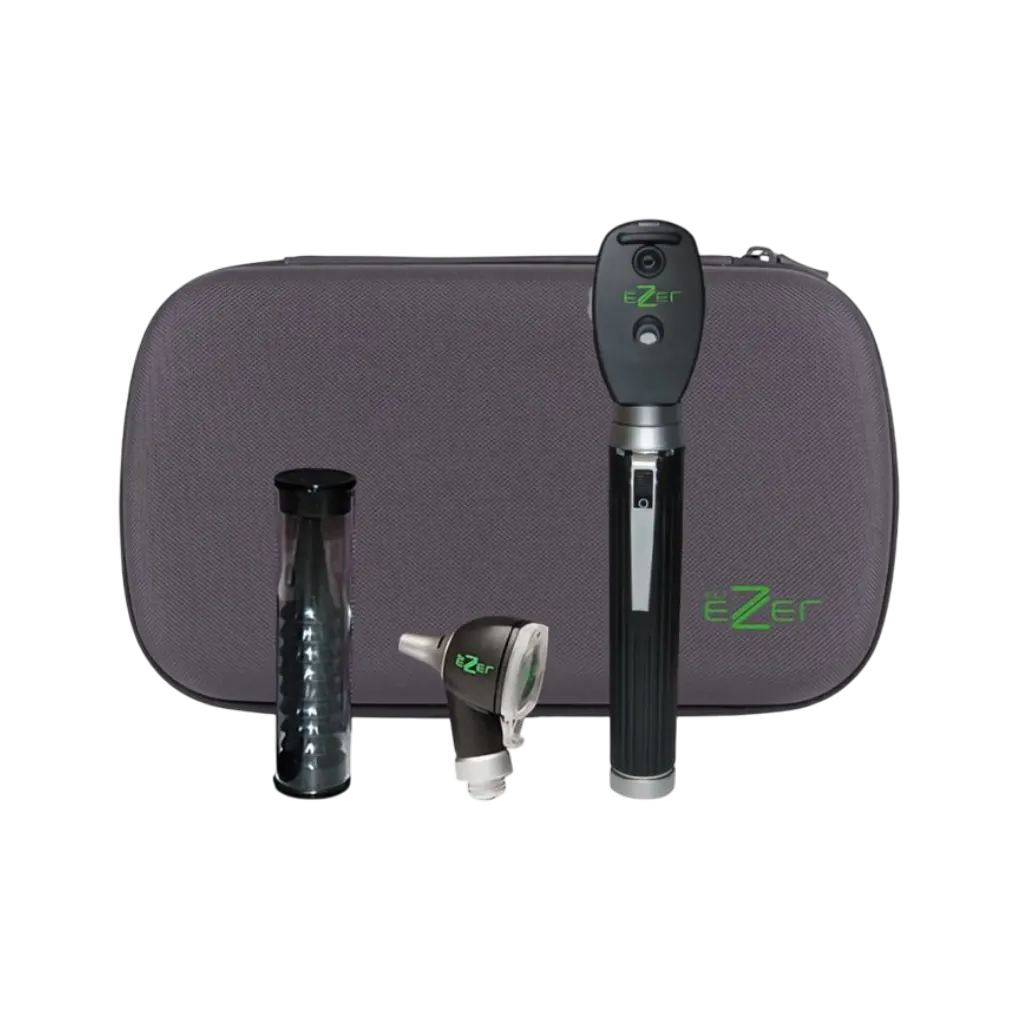
An ophthalmoscope otoscope set is one of the few instruments that gets picked up in almost every exam: a direct ophthalmoscope head and an otoscope head that share a power source, either a handheld battery handle or a wall-mounted transformer. The first decision is not which brand — it is which format. A portable set travels in a case; a wall-mounted set lives in one room and is always powered. This guide walks through that choice, what to compare between sets, and how the Ezer and Neitz sets and wall units we supply differ.
Throughout, “set” means the ophthalmoscope-plus-otoscope kit, which many catalogs label an instrument or exam set. Some sets swap the otoscope for a streak retinoscope; we cover that variant too, because for many eye-care practices it is the more useful pairing.
Shopping for Browse ophthalmoscope sets? US Ophthalmic is a direct provider of Browse ophthalmoscope sets to eye care practices across the US. Tell us how your lane is set up and we will come back with the configurations that fit, plus current availability and lead times.
Wall-mounted vs portable: the format decision
Buyer guides from general-practice suppliers usually split these sets into three groups — portable, wall-mounted and student sets — and that split works for eye-care practices as well. The difference is where the power lives.
Portable (handheld) sets
A portable set puts the power in the handle. The heads twist onto a battery handle, and everything packs into a zippered or hard-shell case. That is what you want for a doctor who moves between rooms or locations, works screenings or nursing-home visits, or needs a backup set for a satellite office. The trade-off is battery management: someone has to keep cells fresh or keep rechargeable handles on their charger.
Wall-mounted sets (wall units / wall transformers)
A wall unit mounts in the exam room and powers two handles on coiled cords. The handles live in cradles on the unit, so they do not walk off to another room, and they are ready whenever the doctor reaches for them. Vendors of wall systems point to the same benefits: quick access to mounted tools, fewer misplaced handhelds and a less cluttered counter. The trade-off is that a wall unit stays in that room — it cannot go on a home visit — and every room that needs one gets its own.
A quick rule of thumb
| Your situation | Format that usually fits |
|---|---|
| Fixed exam rooms, several doctors, steady patient flow | A wall unit in each room |
| One doctor rotating between rooms or offices | A portable set, rechargeable if used daily |
| Screenings, outreach, home or facility visits | A portable set in a hard case |
| Students and residents | A compact pocket set on AA batteries |
| Wall unit wanted, but no outlet where it should hang | A wall unit that can also run on batteries |
Plenty of practices end up with both: wall units in the main lanes and one portable set for the screening bag. If you are building a mobile setup, our mobile eye clinic equipment guide covers the rest of that kit.
What to compare between ophthalmoscope and otoscope sets
1. Which heads come in the set
Most sets pair a direct ophthalmoscope with an otoscope. A refraction-focused practice may get more daily use from an ophthalmoscope-and-retinoscope set instead — the Neitz NTZ-OPH/RET SET BXa-RC-RX, for example, pairs the NTZ-OPH-BXa-RC direct ophthalmoscope with the NTZ-RET-RX-RC streak retinoscope on a rechargeable handle. If retinoscopy is the bigger part of your day, read our retinoscopy equipment guide before deciding. On wall units, check head compatibility: the Ezer EZ-WTC-5200 is listed as compatible with ophthalmoscope, retinoscope and otoscope heads, while the EZ-WTF-5200 ships without heads, so you add the ones you need.
2. Ophthalmoscope lens range and apertures
The ophthalmoscope’s lens wheel decides how far it can compensate for the patient’s and the examiner’s refractive error, and the aperture set decides how useful it is with small pupils and for contrast work. The spread across our range is wide:
- Ezer EZ-OTO-1200, EZ-OTO-1800 and the EZ-WOT-1800 wall unit: 19 lenses from 0 D to ±20 D (0, ±1, ±2, ±3, ±4, ±6, ±8, ±10, ±15, ±20 D), with red-free filter, large spot, small spot, fixation aperture and a hemi-spot (a slit aperture on the EZ-OTO-1800).
- Neitz NTZ-OTO/OPH-GH-FO: 15 correction lenses from −25 D to +15 D, normal, small and semicircular apertures, a built-in red-free filter and a dust shutter over the optics.
- Neitz NTZ-OPH/OTO-BXa-134FO: the BXα head with a −36 D to +35 D range in 1 D steps, a backlit diopter readout, and a polarizing filter that can be placed in the illumination or observation path and rotated to reduce corneal reflex.
3. Light source: LED vs halogen
Sets still ship with both. The Ezer sets and the EZ-WOT-1800 use a 2.5 V / 1.6 W LED source; the Neitz sets list halogen bulbs (L-30 or L-38 for the ophthalmoscope, L-69 for the otoscope, each 3 V / 2 W). Wall-system vendors make the case for LED on whiter light, steady output over time and no bulb changes. Halogen sets remain a good choice when you value a particular optical system — the Neitz BXα head is one — but budget for spare bulbs and keep one in the case.
4. Otoscope optics and specula
Check the magnification, whether light reaches the tip by fiber optic, whether there is an insufflation port, and which specula fit. The Ezer otoscopes list 2.5× magnification, fiber-optic transmission, a sealed system with an insufflation port, and 2.5 mm and 4.0 mm specula (the wall unit includes five reusable specula of each, with 3 mm and 5 mm optional). The Neitz otoscopes use a 3× rotating lens with fiber-optic illumination and include 20 disposable tips — ten each at 2.5 mm and 4.0 mm. Before you standardize, confirm you can restock the tip size you will use most.
5. Power: AA, C-cell, rechargeable or mains
Power is where formats differ most in daily life:
- AA handles (EZ-OTO-1200, EZ-OTO-1800, NTZ-OTO/OPH-GH-FO) take two AA alkaline or Ni-MH cells — easy to restock anywhere, and the lightest option for a pocket.
- C-cell handles (NTZ-OPH/OTO-BXa-134FO, 134 mm handle) carry more battery in a larger grip.
- Rechargeable sets remove battery runs. The EZ-OTO-1800 ION comes with a charging base that recharges the internal batteries of both instruments at once, in a hard-shell case with a locking closure.
- Mains wall units run from the outlet. The EZ-WTF-5200 accepts 100–240 VAC, 50/60 Hz and holds a constant 3.5 V output regardless of mains fluctuations.
- Hybrid wall units cover the gap: the EZ-WTC-5200 DC runs from a 5 V DC adapter or from three C cells, so it keeps working during a power outage, can hang on a wall with no outlet nearby, or can sit on a wheeled stand.
One detail that applies to all of them: the published specifications rate these instruments for intermittent use (the Ezer sets list 2 minutes on, 5 minutes off), which matches normal exam use but is worth knowing if a student plans long practice sessions.
6. Wall-unit details that matter in a busy room
- Automatic on/off. The EZ-WTC-5200 DC and EZ-WTF-5200 switch the light on when a handle is lifted and off when it is replaced — no switch to touch, and the lamp is not left burning.
- Cord reach. The EZ-WTF-5200 lists coiled cords with a working radius of up to 3 m. Measure from the planned mounting spot to the patient chair before you drill.
- Brightness control on the handle (EZ-WTF-5200, and on the Ezer portable handles).
- Instrument locks. The EZ-WTF-5200 has locks against unauthorized removal of the instruments — useful in shared or public-facing rooms.
- What is in the box. The EZ-WOT-1800 includes an ophthalmoscope head, an otoscope head and a dispenser; the DC version adds an AC power supply. The EZ-WTF-5200 is the transformer and handles only.
7. Case, weight and build
For portable sets, look at the case as hard as the optics. The EZ-OTO-1200 ships in a zippered carrying case; the EZ-OTO-1800 ION in a hard-shell locking case; the Neitz sets in carrying cases with tips and accessories. The Neitz BXα ophthalmoscope head weighs 70 g and its otoscope head 95 g, and both Neitz pairs are made in Japan.
Our ophthalmoscope sets and wall units at a glance
| Model | Format | Heads | Power | Light |
|---|---|---|---|---|
| Ezer EZ-OTO-1200 | Pocket set, zippered case | Ophthalmoscope + otoscope | 2 × AA (alkaline or Ni-MH) | LED, fiber-optic otoscope |
| Ezer EZ-OTO-1800 | Pocket set | Ophthalmoscope + otoscope | 2 × AA (alkaline or Ni-MH) | LED, fiber-optic otoscope |
| Ezer EZ-OTO-1800 ION | Rechargeable set, hard case | Ophthalmoscope + otoscope | Internal batteries, dual charging base | LED, fiber-optic otoscope |
| Neitz NTZ-OTO/OPH-GH-FO | Pocket set | Ophthalmoscope + otoscope | 2 × AA | Halogen, fiber-optic otoscope |
| Neitz NTZ-OPH/OTO-BXa-134FO | Portable set | BXα ophthalmoscope + otoscope | C-cell handle | Halogen, polarizing filter |
| Neitz NTZ-OPH/RET SET BXa-RC-RX | Portable set | Ophthalmoscope + streak retinoscope | Rechargeable handle | Halogen |
| Ezer EZ-WOT-1800 | Wall unit | Ophthalmoscope + otoscope included | C cells (DC version adds AC supply) | LED |
| Ezer EZ-WTC-5200 | Wall transformer, 2 handles | Ophthalmoscope / retinoscope / otoscope heads | Mains; DC version: adapter or 3 × C | — |
| Ezer EZ-WTF-5200 | Wall transformer with extension | Heads not included | 100–240 VAC, 2 × 3.5 V output | — |
Browse the full range in our instrument sets collection and the wall units collection. If you only need a standalone instrument, see the ophthalmoscopes and otoscopes collections, and our direct ophthalmoscope and retinoscope buying guide for a deeper look at single heads.
How to choose: a seven-point checklist
- Count the rooms and the people. Fixed rooms with several doctors point to a wall unit per room; one roaming doctor points to a portable set.
- Pick the head pair. Ophthalmoscope + otoscope for general exams; ophthalmoscope + retinoscope for refraction-heavy lanes.
- Match the lens range to your work. A ±20 D range covers routine fundus viewing; a −36 to +35 D range in 1 D steps gives more headroom for high refractive errors.
- Decide LED or halogen — and if halogen, keep spare bulbs on hand.
- Choose the power model you can maintain: AA for simplicity, rechargeable for daily heavy use, mains or hybrid for wall units.
- For wall units, measure first: outlet location, cord reach to the chair, and whether you need battery backup.
- Standardize specula and spares across rooms so tips and bulbs are interchangeable.
When the set arrives
- Check the box contents against the listing — heads, handles, case, specula, batteries or charging base.
- For rechargeable sets, give the handles a full charge before the first clinic day.
- For wall units, confirm the mounting surface and hardware before drilling, and leave room for the handles to sit fully in their cradles so automatic on/off works.
- Run each head through its lens wheel and apertures and test the brightness control.
Need help matching sets to rooms? REQUEST QUOTE and tell us how many lanes you are equipping. US Ophthalmic sells new equipment backed by US warranty and service support; ask about open-box availability if you are working to a budget.
FAQ
What is an ophthalmoscope otoscope set?
It is an instrument set that pairs a direct ophthalmoscope head and an otoscope head with a shared power source — a battery handle for portable sets or a transformer for wall-mounted units.
Is a wall-mounted ophthalmoscope set better than a portable one?
Neither is better in general. A wall unit suits a fixed exam room because it is always powered and the handles stay in the room. A portable set suits a doctor who moves between rooms, sites or outreach events.
Can a wall unit work without a nearby outlet?
Some can. The Ezer EZ-WTC-5200 DC runs from a 5 V DC adapter or from three C cells, so it can be mounted away from an outlet, used on a wheeled stand, or keep working during a power outage.
LED or halogen — which should I choose?
LED heads need no bulb changes and give a consistent white light. Halogen sets such as the Neitz BXα still offer strong optical features, but plan to keep spare bulbs.
Can I get a set with a retinoscope instead of an otoscope?
Yes. The Neitz NTZ-OPH/RET SET BXa-RC-RX pairs a direct ophthalmoscope with a streak retinoscope on a rechargeable handle.
Do you sell refurbished or used ophthalmoscope sets?
No. US Ophthalmic sells new equipment, not refurbished or used units. Ask our team about open-box availability and financing when you request a quote.
Ready to spec your Browse ophthalmoscope sets?
Send us your requirements and our equipment specialists will come back with a configuration built around how your practice actually works — including availability and lead time. US Ophthalmic is a direct provider to eye care practices nationwide.