














Best Handheld Autorefractors in 2026
The Ezer ERH-770 is our top handheld autorefractor for 2026. Compare it with Adaptica 2WIN, Nidek HandyRef-K, plusoptiX and Spot on specs and fit.
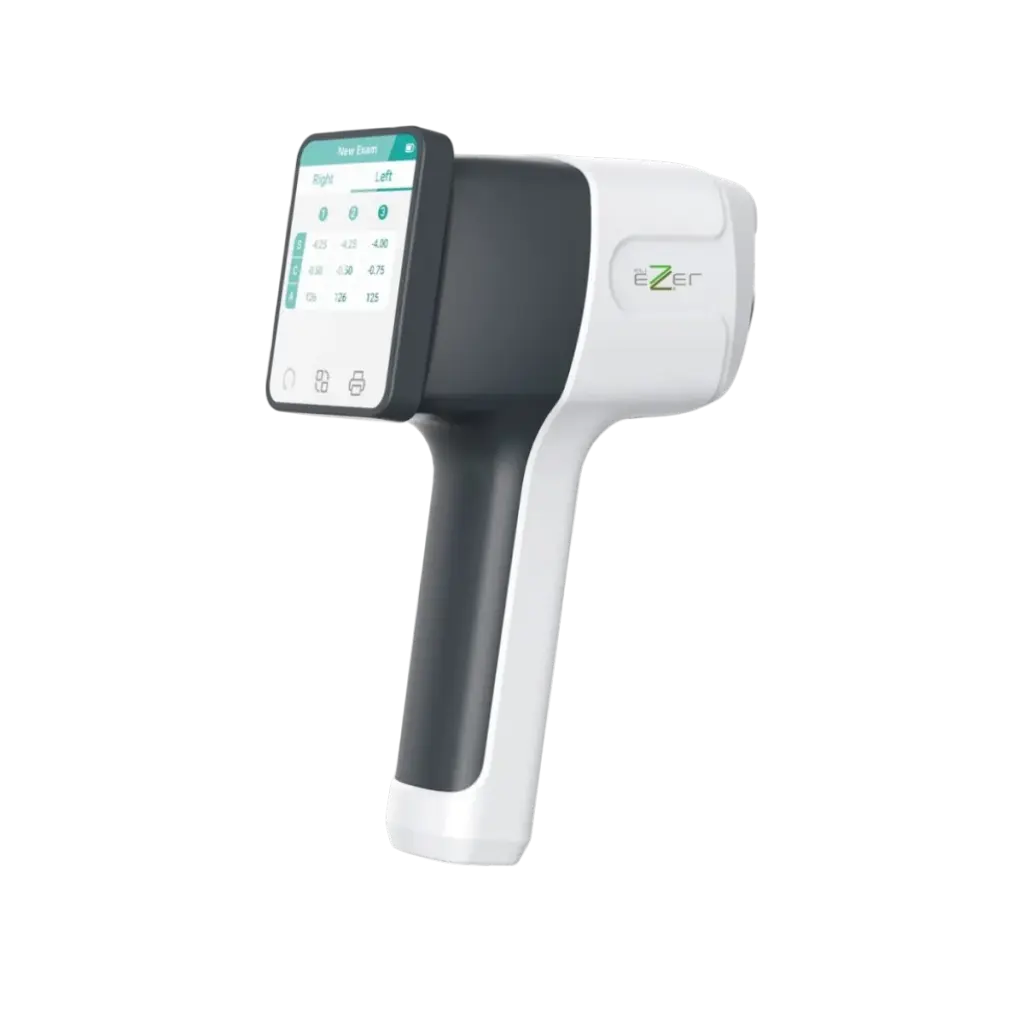
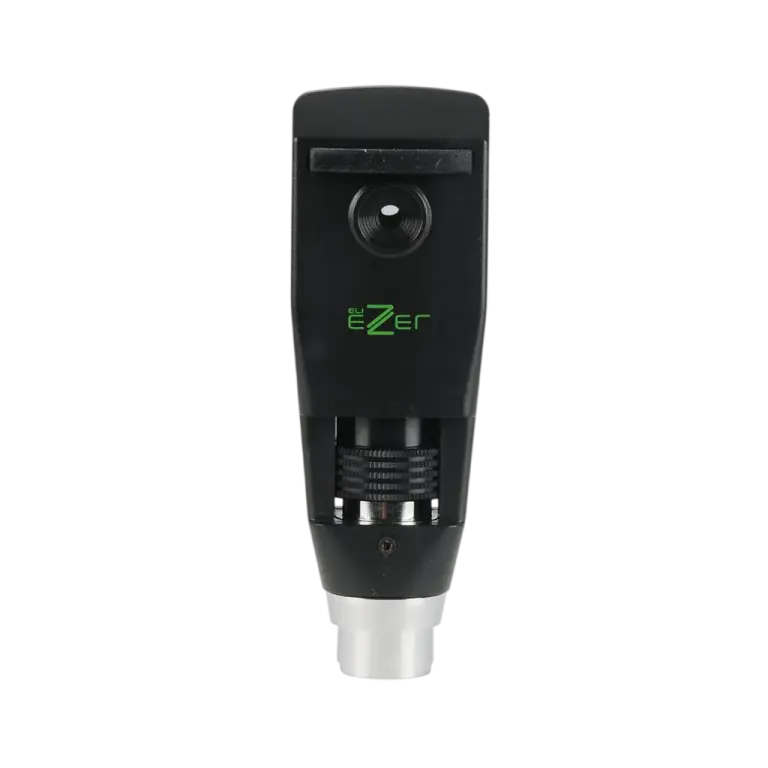
Our top pick for 2026 is the Ezer ERH-770 Handheld Autorefractor. It uses a Shack-Hartmann wavefront sensor, covers a -20 D to +20 D sphere and -12 D to +12 D cylinder range, returns a reading in under 2 seconds per eye, and prints over Bluetooth, all in a device built for home visits, screenings and satellite clinics. Because Ezer is US Ophthalmic's own manufactured brand, it also comes with a direct line to the people who build, service and stock parts for it.
Handheld autorefraction is not one category but two. Monocular, eyepiece-style instruments such as the ERH-770 and the Nidek HandyRef-K are held close to the eye and aim to give a tabletop-like objective refraction anywhere. Binocular photorefractors such as the Adaptica 2WIN, the plusoptiX A20 and the Welch Allyn Spot Vision Screener work like a camera from about one meter, which makes them easier with infants and patients who cannot sit at a chinrest, but they trade away some measurement range.
Below we compare six current models on the criteria that matter in a real practice: measurement principle, range, patient fit, data handling, portability and support. Every specification listed comes from the manufacturer's own page or brochure. If you need a tabletop autorefractor-keratometer or a dedicated pediatric screener, see our separate guides for those categories.
Shopping for autorefractors? US Ophthalmic is a direct provider of autorefractors to eye care practices across the US. Tell us how your lane is set up and we will come back with the configurations that fit, plus current availability and lead times.
How to choose a handheld autorefractor
- Measurement principle: Wavefront (Shack-Hartmann) and pupil-zone imaging instruments are held close to the eye and measure one eye at a time. Photorefraction devices measure both eyes from about one meter. Decide whether you need a near-tabletop refraction or a fast binocular capture.
- Sphere and cylinder range: Ranges vary widely, from about ±7.5 D spherical equivalent on screening-oriented devices to ±20 D sphere on clinical handhelds. High myopes, aphakic patients and post-surgical follow-up need the wider range.
- Patient population: Infants, wheelchair users, bedbound and non-cooperative patients favor a one-meter, camera-style device. Adults in nursing homes, outreach clinics and home visits are well served by an eyepiece-style handheld.
- Keratometry: Some handhelds add keratometry, which helps with contact lens and pre-surgical workups outside the main exam lane. If you already own a tabletop keratometer, a refraction-only model may be enough.
- Data output and EMR: Check how results leave the device: Bluetooth or infrared printing, Wi-Fi, USB, microSD, or direct EMR export. Screening programs that see many patients benefit most from wireless reporting.
- Weight, battery and ergonomics: You may hold the device for a long session. Compare published weights, battery arrangements and whether the unit has features such as supine mode or axis correction for patients lying down.
- Local service and parts: A handheld instrument travels and gets dropped. A US provider with an in-house technical department and spare-parts stock shortens downtime more than any spec line.
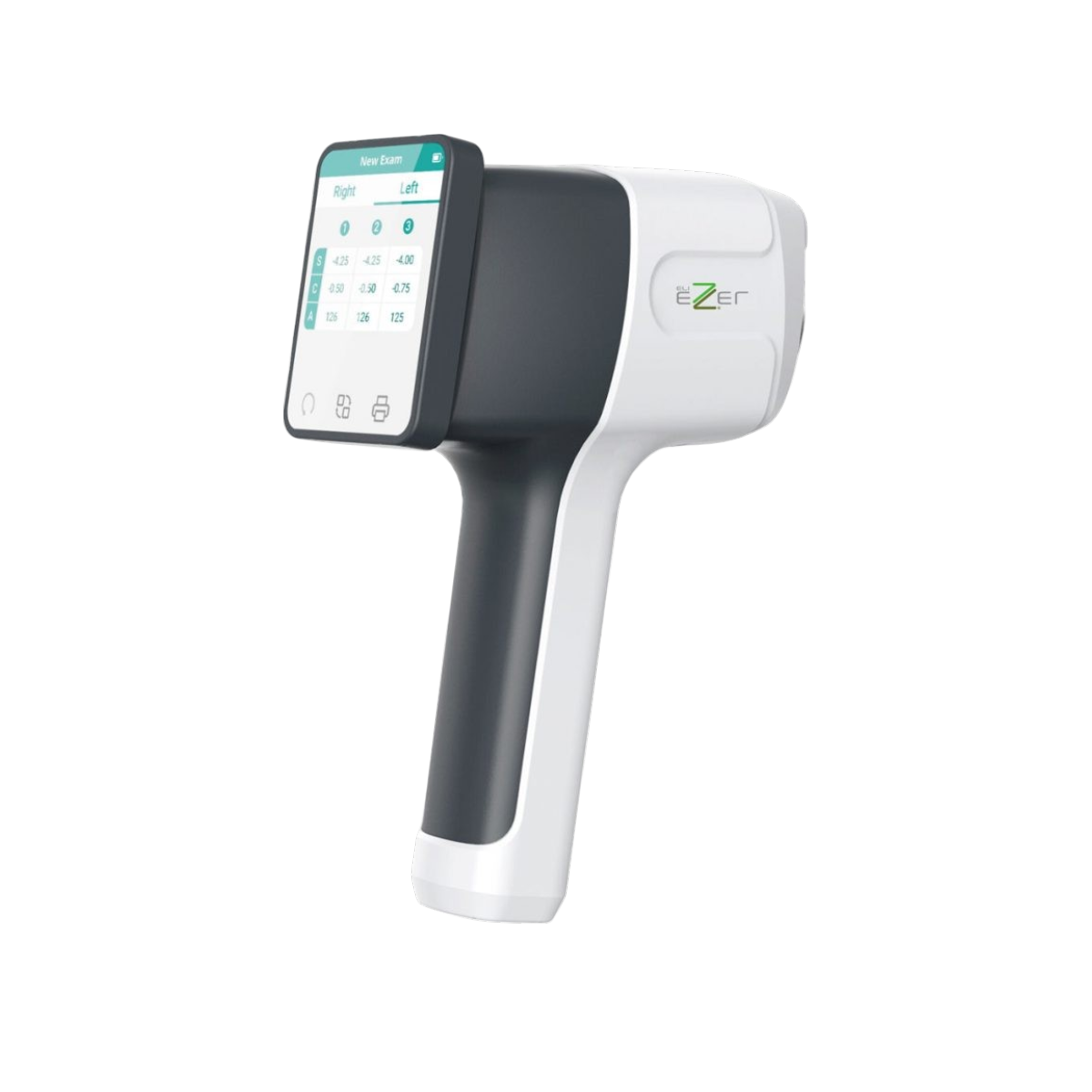
#1 · Ezer ERH-770 Handheld Autorefractor (Ezer)
Best overall: wide-range wavefront refraction in a true handheld, backed by the manufacturer's own US service.
The ERH-770 is built around a Shack-Hartmann aberrometer, the same wavefront principle used in many high-end refraction systems, packaged in a handheld body you can carry into a nursing home, a school gym or a post-op visit. Ezer lists a spherical range of -20 D to +20 D, a cylindrical range of -12 D to +12 D and a 1° to 180° axis range, which covers far more of the refractive spectrum than the one-meter screeners in this guide. Measurements take less than 2 seconds per eye, so throughput holds up in busy screening sessions. A 2.8-inch touch screen drives the workflow, and results go to a Bluetooth printer, which keeps the kit simple when you are working away from the office network. The practical advantage is ownership of the supply chain: Ezer is US Ophthalmic's house brand, so training, repairs and spare parts come from the same team that supplies the device rather than through a chain of third parties. If your main need is fast objective refraction for adults and older children outside the exam lane, this is the most complete package here.
Pros: Shack-Hartmann wavefront measurement · Wide range: -20 D to +20 D sphere, -12 D to +12 D cylinder · Under 2 seconds per eye · Bluetooth printing for field work · Manufacturer-direct US service and parts
Considerations: Measures each eye separately rather than both at once from a distance, so less suited to infants than a one-meter binocular device · Weight, battery and keratometry are not listed on the published spec sheet
Best for: Practices and outreach programs that want tabletop-class objective refraction in home visits, nursing homes, screenings and post-op follow-up.
View the Ezer ERH-770 Handheld Autorefractor & request a quote →
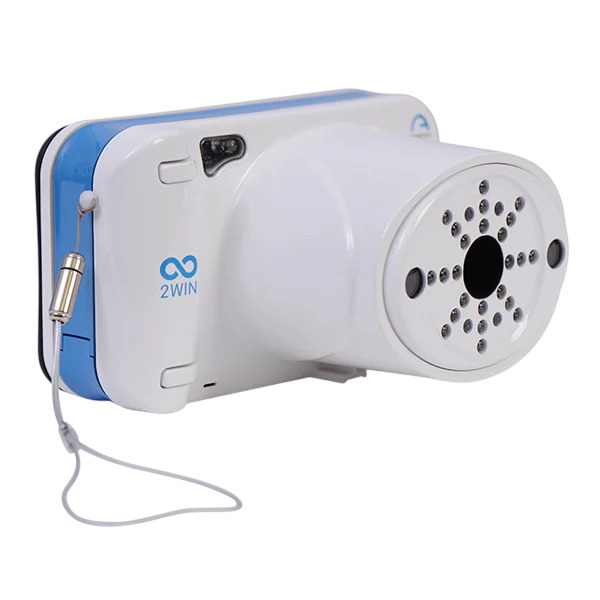
#2 · Adaptica 2WIN (Adaptica)
Best for children and non-cooperative patients: a binocular, camera-style refractor and vision analyzer.
The 2WIN measures both eyes at once from a working distance of 1 m ± 5 cm using eccentric infrared photo-retinoscopy, so patients simply look toward the device under natural viewing conditions. Adaptica lists a sphere range of ±15 D (0.25 D steps within ±7 D, 0.50 D steps beyond), a cylinder range of ±5 D and an axis range of 1° to 180°. Beyond refraction it reports pupil size, pupillary distance, binocular alignment, gaze and dynamic pupil response, and the infrared image can show media opacities. A 3.5-inch display, Wi-Fi, USB and microSD storage make it easy to save and share PDF reports, and printing is available over USB or infrared. At 840 g it is light enough for a full day of screenings. It is positioned for pediatric offices, orthoptics, mobile eye care and occupational medicine. The trade-off is range: the cylinder ceiling of ±5 D is lower than eyepiece-style handhelds, so it complements rather than replaces a full refraction for high astigmats.
Pros: Binocular capture from 1 m, no chinrest · Works for infants, children and patients with disabilities · Pupillometry, PD, alignment and gaze data · Wi-Fi, USB and microSD reporting · 840 g
Considerations: Cylinder range limited to ±5 D · Coarser 0.50 D steps beyond ±7 D sphere
Best for: Pediatric, orthoptic and mixed-population practices that need a fast binocular capture from a distance.
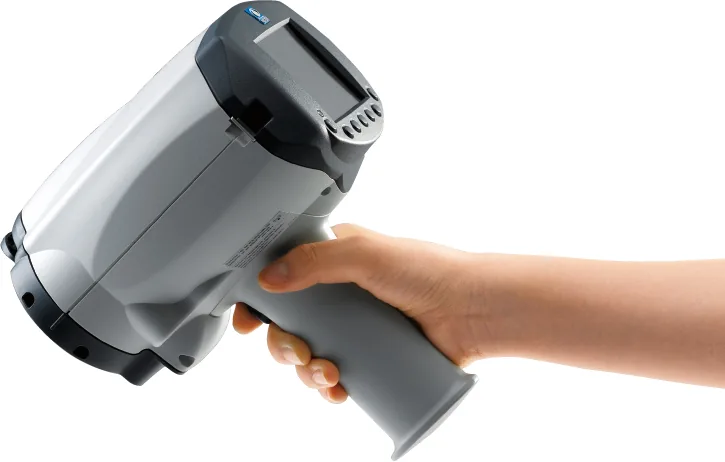
#3 · Nidek HandyRef-K (Nidek)
Strongest competitor for clinic use: handheld refraction plus keratometry.
The HandyRef-K is a pistol-grip handheld ref/keratometer. Nidek's brochure lists a sphere range of -20.00 to +20.00 D (at a 12 mm vertex distance), cylinder of 0 to ±12.00 D and axis of 0 to 180°, with a minimum measurable pupil of 2 mm. The keratometer measures a curvature radius of 5.00 to 13.00 mm, which is useful for contact lens or pre-surgical work outside the main lane. Nidek's pupil zone imaging analyzes an area up to 4 mm in diameter, and its auto-shot mode captures data once alignment and focus are optimal. A 3.5-inch color LCD, automatic supine mode when tilted downward, axis correction and a melody function for children round out the usability features. The main body weighs 998 g including the battery pack, and it offers USB plus WLAN on WLAN-equipped models. An optional station adds a thermal printer, LAN and RS-232C. Nidek notes that its brochure is intended for non-US practitioners and that availability varies by country, so confirm the configuration offered in the US.
Pros: Refraction plus keratometry in one handheld · -20 D to +20 D sphere, 0 to ±12 D cylinder · Works down to 2 mm pupils · Supine mode and axis correction · Optional printer station
Considerations: Monocular, eyepiece-style, so harder with very young children · 998 g main body · US configuration should be confirmed with the manufacturer
Best for: Clinics that want keratometry as well as refraction from a single portable device, including bedside and surgical settings.
#4 · Nidek HandyRef (Nidek)
The refraction-only sibling of the HandyRef-K for buyers who already own a keratometer.
The HandyRef shares its body, display and measurement method with the HandyRef-K but omits keratometry. Nidek lists the same refraction specifications: sphere -20.00 to +20.00 D at a 12 mm vertex distance, cylinder 0 to ±12.00 D, axis 0 to 180° in 1° or 5° steps, and a 2 mm minimum pupil. SynchroScan technology starts measuring as soon as alignment begins and locks in the reading when alignment is optimal, and the auto-shot mode repeats a measurement automatically if unstable data is included. Practical touches include a 3.5-inch color LCD, a supine position mode that compensates the cylinder axis when measuring from the patient's side, an automatic axis correction sensor and a choice of scenery or children's fixation targets. Battery is a 7.2 V lithium-ion pack, and the optional station supports printing and wired connections. For a practice whose priority is refraction in wheelchairs, beds and outreach sites, the HandyRef delivers the HandyRef-K's range without paying for a keratometer you may not use. As with the K model, check the US-available configuration directly with Nidek.
Pros: Same wide refraction range as the HandyRef-K · Auto-shot and SynchroScan capture · Supine mode and axis correction · Child-friendly fixation target and melody
Considerations: No keratometry · Monocular, eyepiece-style operation · Approximately 1 kg main body per Nidek's shared spec sheet
Best for: Practices that want a wide-range handheld refraction and already have keratometry covered elsewhere.
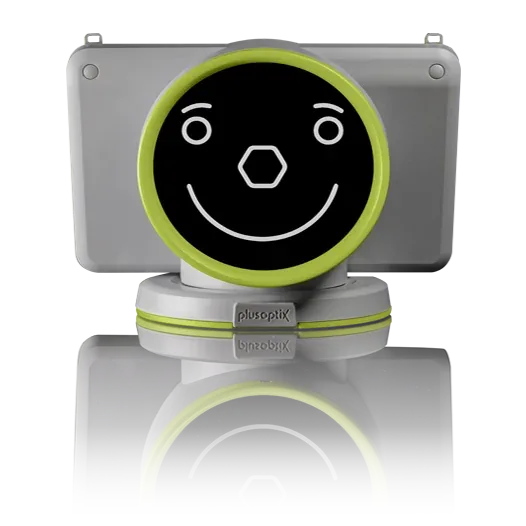
#5 · plusoptiX A20 (Plusoptix)
A binocular one-meter autorefractor with a large touchscreen and EMR connectivity.
Plusoptix's current binocular autorefractor line is led by the A20 (the A16 named in many older comparisons is no longer listed among Plusoptix's current autorefractors, which show the A20 and A12R). Like other Plusoptix autorefractors, it measures sphere, cylinder and axis of both eyes simultaneously from one meter away in less than a second, and Plusoptix notes that this distance avoids so-called device myopia and that cylinder and axis readings are taken without dilation. At the end of each capture an image is displayed that lets an experienced user spot media opacities within the pupil. The A20 adds automatic distance measurement to help position the device, a 7-inch touchscreen and the option to send results to an EMR or document them on paper; Plusoptix positions it for mobile use across several exam rooms. The lower-cost A12R drops direct EMR transfer and documents to an SD card or optional wireless label printer. Plusoptix does not publish the A20's measurement range on its autorefractor page, so request the technical data sheet before comparing it to wider-range handhelds.
Pros: Both eyes measured at once from 1 m · Measurement in under a second · 7-inch touchscreen and automatic distance measurement · EMR or paper documentation
Considerations: Measurement range not published on the manufacturer's product page · Larger, camera-and-stand form factor than a pistol-grip handheld · No keratometry
Best for: Multi-room practices that want a fast binocular baseline refraction with digital records.
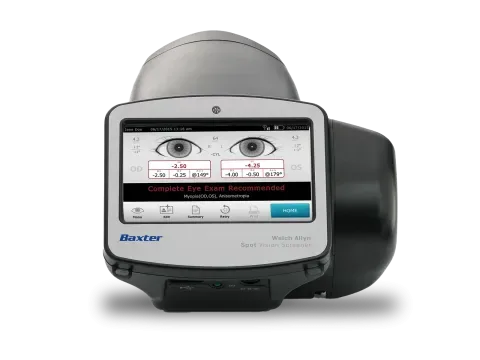
#6 · Welch Allyn Spot Vision Screener (VS100) (Welch Allyn (Baxter))
A widely used screener-autorefractor, best viewed as a screening tool rather than a refraction replacement.
The Spot Vision Screener, now sold under Baxter (formerly Hillrom), is a handheld point-and-shoot device that auto-captures both eyes from a measuring distance of 3.3 ft. Its specification sheet lists a spherical equivalent range of -7.5 D to +7.5 D and a cylindrical range of -3.00 D to +3.00 D in 0.25 D increments, pupil sizes from 3.0 to 9.0 mm and gaze measurement of 0 to 20 degrees. It weighs about 1,157 g, and Baxter states the battery lasts over four hours per charge with a two-hour recharge. Baxter positions it for screening patients as young as six months for six amblyopic risk factors, with lights and sounds to hold a child's attention. Workflow is a strength: driverless Wi-Fi printing, USB export and the SpotConnect application for Epic and Cerner EMR integration. Software updates require returning the unit to Baxter's service facility. Its narrower range and screening-oriented reports mean most eye care practices will use it alongside, not instead of, a full-range handheld autorefractor.
Pros: Auto-capture of both eyes from 3.3 ft · EMR integration with Epic and Cerner via SpotConnect · Wireless driverless printing · Over four hours of battery per charge
Considerations: Narrow range: ±7.5 D spherical equivalent, ±3.00 D cylinder · Screening-oriented results · Software updates require shipping the unit to the service facility · About 1,157 g
Best for: Pediatric and primary care settings, school programs and practices adding instrument-based screening alongside their main refraction tools.
Feature comparison
| Model | Type | Measurement principle | Sphere range | Cylinder range | Keratometry | Working distance | Display | Data output | Weight |
|---|---|---|---|---|---|---|---|---|---|
| Ezer ERH-770 | Handheld | Shack-Hartmann wavefront | -20 D to +20 D | -12 D to +12 D | — | — | 2.8 in touch screen | Bluetooth printer | — |
| Adaptica 2WIN | Handheld, binocular | Eccentric infrared photo-retinoscopy | ±15 D | ±5 D | No | 1 m ± 5 cm | 3.5 in | Wi-Fi, USB, microSD; USB/IrDA printer | 840 g |
| Nidek HandyRef-K | Handheld, monocular | Pupil zone imaging | -20.00 to +20.00 D | 0 to ±12.00 D | Yes (5.00–13.00 mm) | — | 3.5 in color LCD | USB; WLAN (WLAN model); station adds printer, LAN, RS-232C | 998 g incl. battery |
| Nidek HandyRef | Handheld, monocular | Pupil zone imaging | -20.00 to +20.00 D | 0 to ±12.00 D | No | — | 3.5 in color LCD | USB; WLAN (WLAN model); station adds printer, LAN, RS-232C | 998 g incl. battery |
| plusoptiX A20 | Portable, binocular | — | — | — | No | 1 m | 7 in touchscreen | EMR transfer or paper | — |
| Welch Allyn Spot Vision Screener | Handheld, binocular | — | -7.5 D to +7.5 D (spherical equivalent) | -3.00 D to +3.00 D | No | 3.3 ft | — | Wi-Fi printing, USB, EMR via SpotConnect | ~1,157 g |
Why it’s our top pick
US Ophthalmic manufactures the Ezer line, so the ERH-770 is supported by the same company that supplies it. Our in-house technical department handles setup questions and repairs, and our spare-parts department keeps components on hand, which matters for a device that travels between offices, homes and screening sites. New equipment ships with a US warranty, and pricing is provided by quote so we can match the configuration and accessories to how you will actually use the device.
We also carry the Adaptica 2WIN for practices whose patient mix leans toward infants, children and non-cooperative patients. Many practices pair the two: the ERH-770 for wide-range objective refraction and the 2WIN for fast binocular capture from a distance. Our team can help you decide whether one device or both fits your workflow.
Ready to spec your autorefractors?
Send us your requirements and our equipment specialists will come back with a configuration built around how your practice actually works — including availability and lead time. US Ophthalmic is a direct provider to eye care practices nationwide.
Frequently asked questions
What is the best handheld autorefractor in 2026? For most practices we recommend the Ezer ERH-770. It combines Shack-Hartmann wavefront measurement, a -20 D to +20 D sphere and -12 D to +12 D cylinder range, readings in under 2 seconds per eye and Bluetooth printing, with manufacturer-direct US service from US Ophthalmic. If your patients are mostly infants and young children, a one-meter binocular device such as the Adaptica 2WIN may suit you better.
What is the difference between a handheld autorefractor and a vision screener? Eyepiece-style handheld autorefractors like the ERH-770 or Nidek HandyRef-K measure one eye at a time close up and aim for a full objective refraction across a wide range. Vision screeners and photorefractors such as the Spot Vision Screener capture both eyes from about one meter and are designed primarily to flag who needs a complete exam, with narrower measurement ranges.
Can a handheld autorefractor replace my tabletop autorefractor? For mobile, bedside and outreach work, a wide-range handheld can cover most needs. In the main exam lane, many practices still prefer a tabletop autorefractor-keratometer for its chinrest stability and added functions. A handheld is usually a complement, not a replacement.
Which handheld autorefractor works best for infants and young children? Camera-style binocular devices that work from about one meter are the easiest with young children because no chinrest or eyepiece is needed. The 2WIN is specified for patients from two months of age, and Baxter positions the Spot Vision Screener for patients as young as six months.
Do handheld autorefractors measure keratometry? Some do. The Nidek HandyRef-K includes a keratometer with a 5.00 to 13.00 mm curvature radius range, while its sibling HandyRef and the binocular photorefractors in this guide focus on refraction.
How do results get into my records? It depends on the model: the ERH-770 prints over Bluetooth, the 2WIN uses Wi-Fi, USB and microSD with PDF reports, the plusoptiX A20 can send results to an EMR, and the Spot Vision Screener integrates with Epic and Cerner through SpotConnect.
How much does a handheld autorefractor cost? Pricing depends on configuration and accessories. US Ophthalmic provides quotes on request, and financing is available; ask about it when you request your quote.
The verdict
If you want one portable device that delivers a wide-range objective refraction anywhere, the Ezer ERH-770 is our top pick for 2026. Its Shack-Hartmann measurement, -20 D to +20 D sphere and -12 D to +12 D cylinder range, sub-2-second readings and Bluetooth printing cover home visits, nursing homes, screenings and post-op follow-up, and it is backed directly by its manufacturer's US service and parts teams.
Choose the Adaptica 2WIN if most of your portable work involves infants, children or patients who cannot cooperate with an eyepiece. The Nidek HandyRef-K is the strongest outside option when you also need keratometry, and the plusoptiX A20 and Spot Vision Screener make sense where binocular screening and EMR reporting matter more than measurement range.