














Best Manual Phoropters in 2026
Our top manual phoropter for 2026 is the Ezer ERF-5200. Compare it with Reichert, Topcon, Marco, Luxvision and S4OPTIK manual refractors.
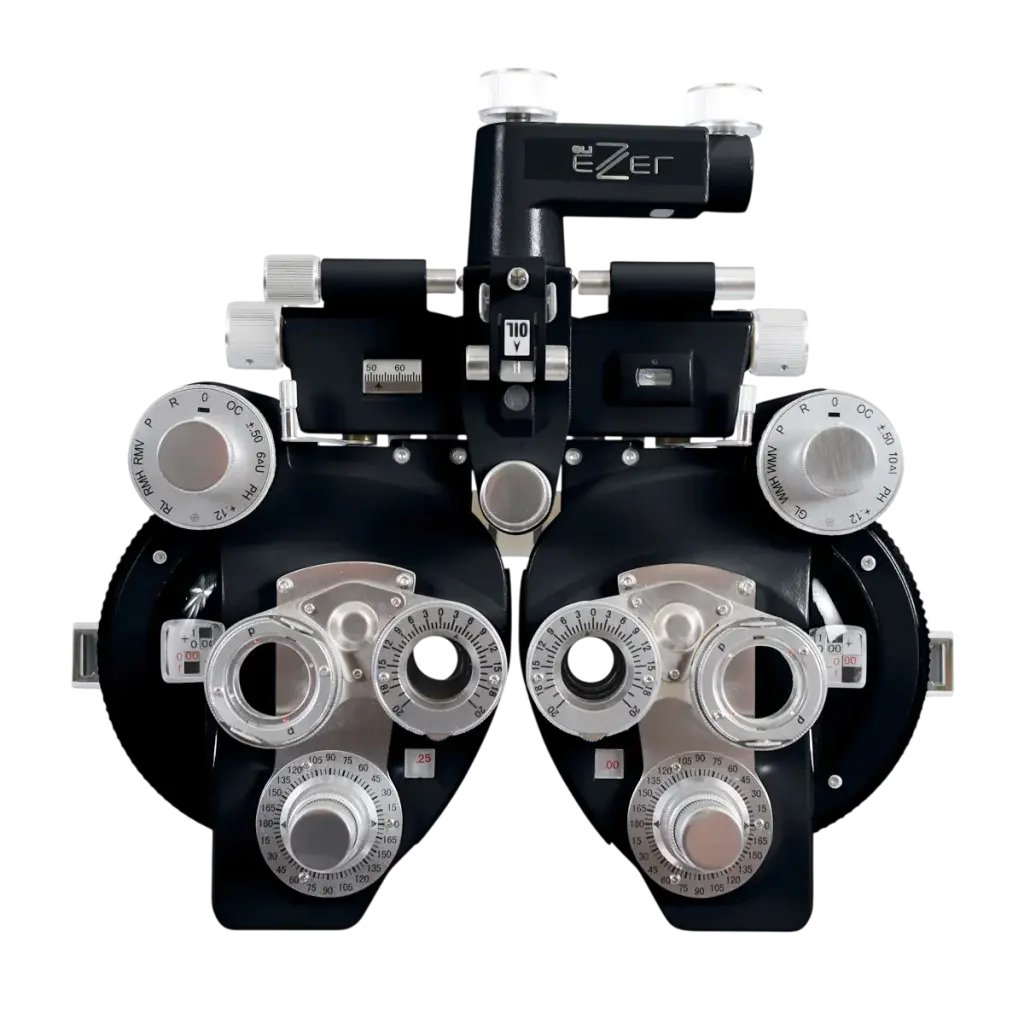
Our top pick for a manual phoropter in 2026 is the Ezer ERF-5200. It covers the full standard refraction range (-19.00D to +16.75D sphere, 0 to -6.00D cylinder, extendable with auxiliary lenses), adds a synchronized cross cylinder, a click-stop rotary prism and a one-lever convergence system, and it is manufactured by US Ophthalmic's own Ezer brand, so parts and service run through the same provider that sells it.
Manual refractors have changed less than almost any other exam-lane instrument, which is exactly why buyers still choose them: no software, no cables, no boot-up, and a mechanism that a trained technician can service for many years. The real differences between models are in build feel, PD and convergence ranges, auxiliary lens complement, cylinder convention (plus or minus), extras such as illuminated dials, and who stands behind the unit after delivery.
This guide covers manual units only. If you are weighing a motorized or computerized head, see our separate digital phoropter guide. Below we explain how to judge a manual refractor, then rank seven current models from Ezer, Reichert, Luxvision, Topcon, Marco and S4OPTIK using specifications published on each manufacturer's own pages.
Shopping for refractors? US Ophthalmic is a direct provider of refractors to eye care practices across the US. Tell us how your lane is set up and we will come back with the configurations that fit, plus current availability and lead times.
How to choose a manual phoropter
- Sphere and cylinder range: Nearly every current manual head reads -19.00D to +16.75D sphere and 0 to 6.00D cylinder in 0.25D steps. What separates them is how far auxiliary lenses extend that range (for example to -8.00D cylinder) and whether a 0.12D refinement step is built into the auxiliary dial or needs an accessory cell.
- Plus or minus cylinder: Optometrists traditionally refract in minus cylinder and many ophthalmologists in plus cylinder. Confirm the head is offered in the convention your doctors use, because the cylinder lens battery is built for one or the other.
- Cross cylinder and prism mechanics: Look for a cross cylinder that rotates automatically with the cylinder axis knob, optional ±0.37D and ±0.50D flip lenses, and a 0 to 20 prism-diopter rotary prism in 1Δ steps. Geared prisms or click stops make small phoria readings easier to repeat.
- PD range and near convergence: A wider interpupillary range (for example 48 to 80 mm) accommodates small adults and large heads without a struggle. A convergence lever that angles the lenses for near testing at roughly 380 to 400 mm keeps near refraction on the optical centers.
- Auxiliary lens dial: Check what is built in: retinoscopy lens, Maddox rods, red/green filters, polarizing filters, pinhole, dissociating prisms, +0.12D sphere and fixed ±0.50D cross cylinder. A fuller dial means fewer loose accessories in the lane.
- Visibility in a dark room: Standard scales are fine with a pen light, but illuminated dials or high-contrast white scales help in a fully darkened lane. Decide whether that convenience is worth it for your workflow.
- Service, parts and support: A manual phoropter is a precision mechanism that needs periodic cleaning, lubrication and adjustment. Ask who services it, how parts are sourced, and what the warranty requires, since some manufacturers tie coverage to registration and regular service.
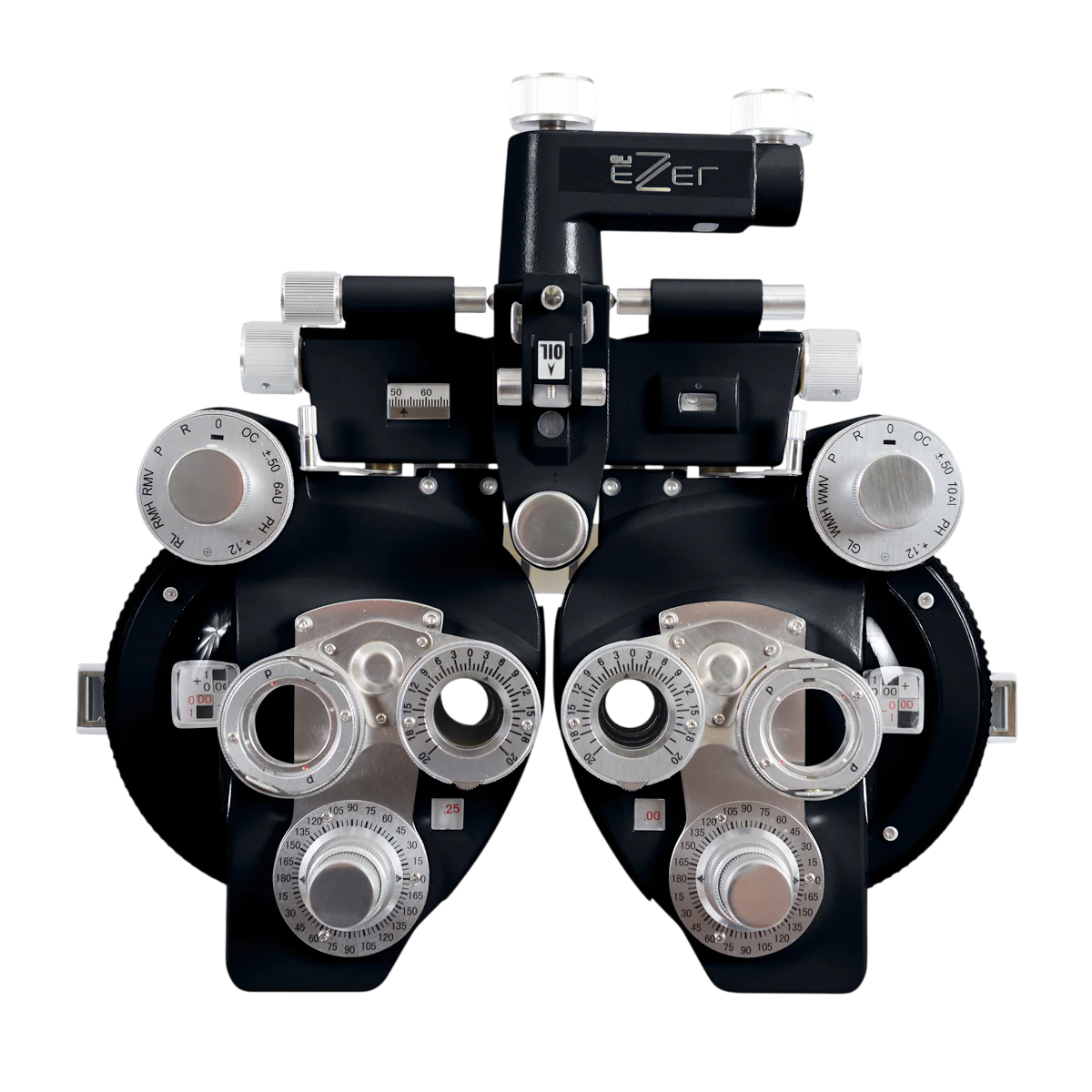
#1 · Ezer ERF-5200 Manual Refractor (Ezer)
Best overall: a complete, well-specified manual refractor backed by the provider that manufactures and services it.
The ERF-5200 is the manual refractor from Ezer, the house brand US Ophthalmic manufactures. It reads sphere from -19.00D to +16.75D in 0.25D steps, extendable to -29.00D and +26.75D with the optional ±10.00D auxiliary lenses, and a 3.00D fast-advance dial speeds large changes. Cylinder runs 0 to -6.00D, or to -8.00D with the included -2.00D auxiliary lenses, with the axis set from 0 to 180 degrees in 5-degree steps. The ±0.25D cross cylinder is synchronized with the axis knob, and ±0.37D and ±0.50D cross-cylinder lenses are optional. The rotary prism covers 0 to 20Δ in 1Δ steps and adds a click stop for horizontal and vertical phoria and strabismus measurements. A single convergence lever switches between distance and near (380 mm at a 64 mm PD), PD adjusts from 50 to 75 mm, and the near-point scale reads in inches, centimeters and diopters with a two-sided 12-test chart. Auxiliary lenses carry a plated coating intended to cut reflections and ghost images. It weighs about 5 kg, comes in black or white, and is sold new with a US warranty, in-house technical support and a spare-parts department behind it.
Pros: Full standard sphere and cylinder range with auxiliary extensions · Click-stop rotary prism for phoria and strabismus work · One-lever distance/near convergence system · 3.00D fast-advance sphere dial · Manufactured, supported and serviced by the same US provider · Black or white finish
Considerations: PD range (50 to 75 mm) is narrower than some competitors · No illuminated dials · Plus-cylinder version is not listed; confirm convention when quoting
Best for: Practices outfitting new or additional lanes that want a full-featured minus-cylinder refractor with direct provider service and parts.
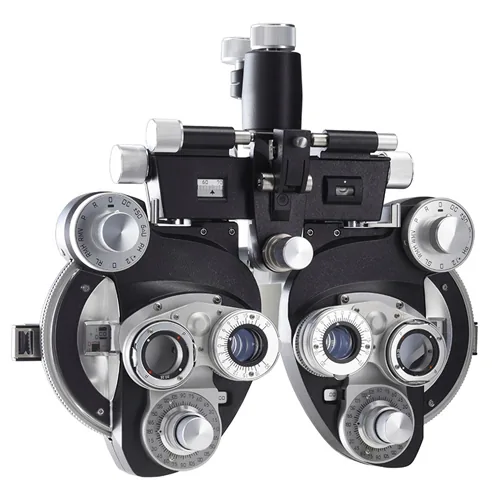
#2 · Reichert Ultramatic RX Master Phoroptor (Reichert)
The benchmark name in manual refraction, with a geared prism and an unusually long warranty commitment.
Reichert trademarked the Phoroptor name over a century ago, and the Ultramatic RX Master remains its traditional manual head. Reichert describes it as American designed and engineered, built from corrosion-resistant materials, with a precision geared rotary prism for finer interpolation of small prism values. Published specifications include sphere from -19.00D to +16.75D in 0.25D steps with a +0.12D sphere in the auxiliary dial, cylinder 0.00 to 6.00D in 0.25D steps with 0.12D and 2.00D accessory cells included, a double 0 to 180 degree axis scale in 5-degree graduations, a ±0.25D cross cylinder, 0 to 20Δ prism, PD from 48 to 75 mm, a 13.75 mm normal vertex distance and a 5 to 28 inch reading distance. The auxiliary dial holds 10 lenses plus 2 open apertures, and the unit ships with a flip cross cylinder, +1.50 retinoscopic lenses, a case, face shields, a Rotochart and a reading rod. It is offered in plus or minus cylinder. Reichert backs it with a limited lifetime warranty for the original purchaser, conditional on product registration and regular service by Reichert or its authorized network at least every three years.
Pros: Long-established design with a distinctive mechanical feel · Precision geared rotary prism · Plus or minus cylinder versions · Generous included accessory kit · Limited lifetime warranty for the original owner
Considerations: Warranty requires registration and documented service at least every three years · Catalog lists black finish only · Cylinder extension relies on accessory cells rather than a built-in -8.00D path
Best for: Doctors who trained on a Phoroptor and want that exact feel, or practices that value a long-term manufacturer warranty program.
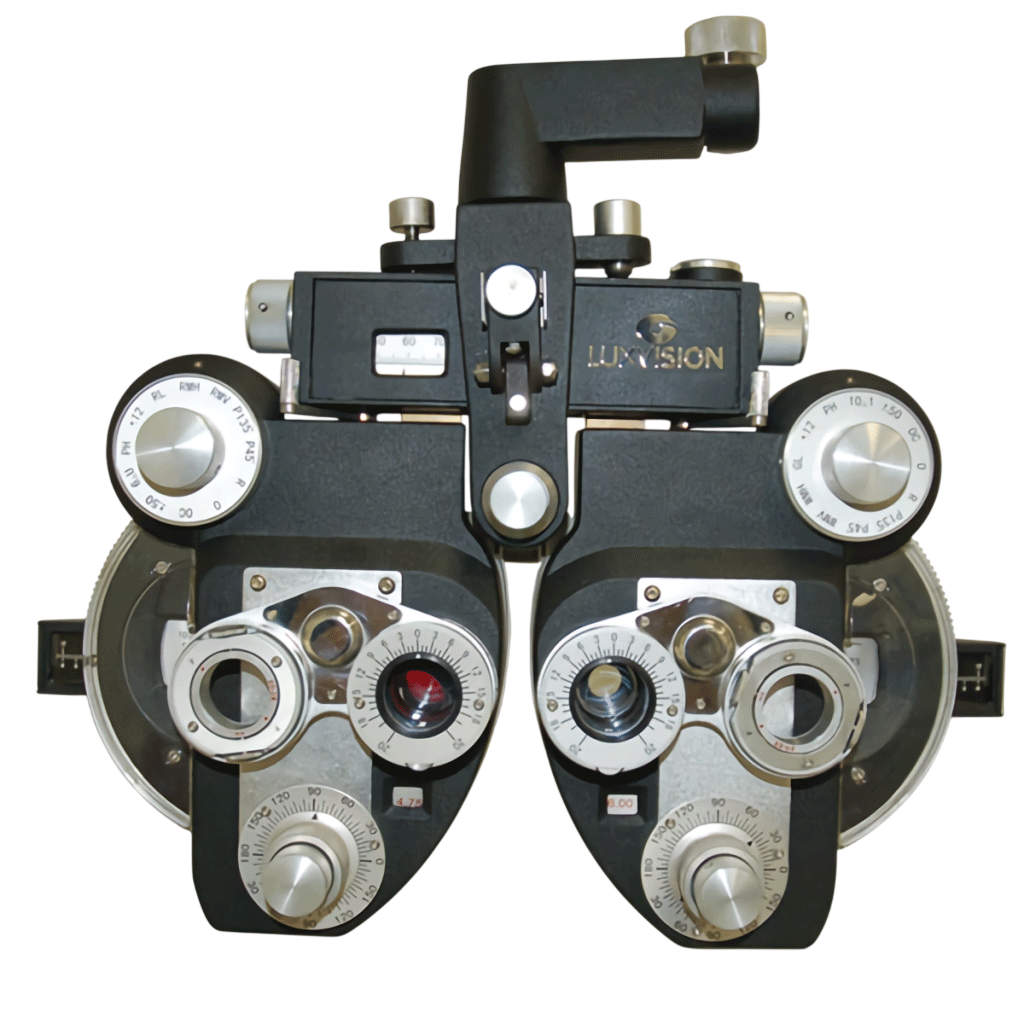
#3 · Luxvision R-2500 Manual Refractor (Luxvision)
Best for wide PD coverage: a feature-rich manual head with built-in auxiliary lenses and a 48 to 80 mm PD range.
The Luxvision R-2500 is a durable manual refractor that US Ophthalmic offers new. Its sphere range is -19.00D to +16.75D in 0.25D steps, extending to -29.00D and +26.75D with optional lenses, and a quick-advance dial changes sphere in 3.00D jumps. Cylinder covers 0 to -6.00D, or -8.00D with the -2.00D auxiliary lens, on a 0 to 180 degree axis scale in 5-degree steps. The ±0.25D reversible cross cylinder is synchronized with the axis, and the product page lists built-in ±0.50D cross-cylinder, +0.12D cylinder and +2.00D retinoscopy auxiliary lenses. The rotary prism reads 0 to 20Δ in 1Δ steps. Its standout spec is interpupillary adjustment from 48 to 80 mm in 1 mm steps, with left and right synchronized, plus a corneal distance device and a 19 mm effective field of view. A convergence lever aligns the optical axes at 400 mm for near testing. It weighs 5 kg, comes in black or white, and ships with -2.00D cylinder auxiliary lenses, a near vision chart kit and sanitary face shields.
Pros: Widest PD range in this guide (48 to 80 mm) · Several auxiliary lenses built in · 3.00D quick-advance sphere dial · Black or white finish · Sold new with US provider support and parts
Considerations: Minus cylinder only per published range · No illuminated scales · Less name recognition than legacy brands among some trainees
Best for: Practices seeing a broad mix of adult patients that want a well-equipped manual head at a value-focused quote.
View the Luxvision R-2500 Manual Refractor & request a quote →
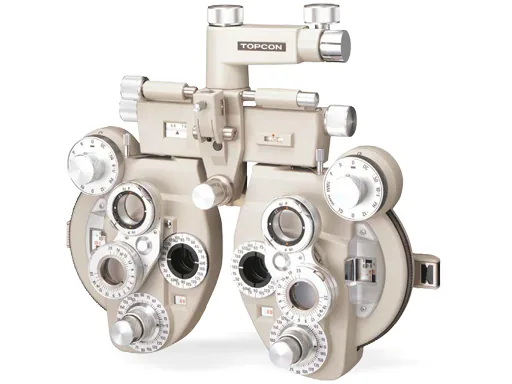
#4 · Topcon VT-10 Vision Tester (Topcon)
A straightforward, well-known manual refractor with a broad built-in auxiliary dial.
Topcon positions the VT-10 as its basic, reliable manual vision tester. According to Topcon's brochure, it reads myopia to -19.00D and hyperopia to +16.75D in 0.25D steps (0.12D with auxiliary lens), and astigmatism from 0 to -6.00D, or -8.00D with an accessory lens. The ±0.25D cross cylinder, with ±0.37D and ±0.50D options, rotates automatically with the set cylinder axis through special gearing. Rotary prisms read from 20Δ to 0 to 20Δ in 1Δ steps for phoria and vergence testing. For near work, a tilt mechanism converges the optical axes at 40 cm at a 64 mm PD. PD adjusts from 48 to 75 mm, level adjustment exceeds 4.5 degrees to each side, and the head weighs 4.5 kg. The auxiliary dial includes open apertures, a +1.50D retinoscopic lens, polarizing filter, white and red Maddox rods, red and green lenses, +0.12D sphere, pinhole, 10Δ base-in and 6Δ base-up dissociating prisms, a ±0.50D fixed cross cylinder and an occluder. Multicoated lenses are standard, and plus- and minus-cylinder models are available in black or light grey.
Pros: Full auxiliary dial including Maddox rods and dissociating prisms · Plus and minus cylinder models · Multicoated lenses · Light at 4.5 kg
Considerations: PD tops out at 75 mm · Convergence stops when distance PD is under 54 mm · No illuminated scales
Best for: Lanes already standardized on Topcon instruments that want a simple, conventional manual head.
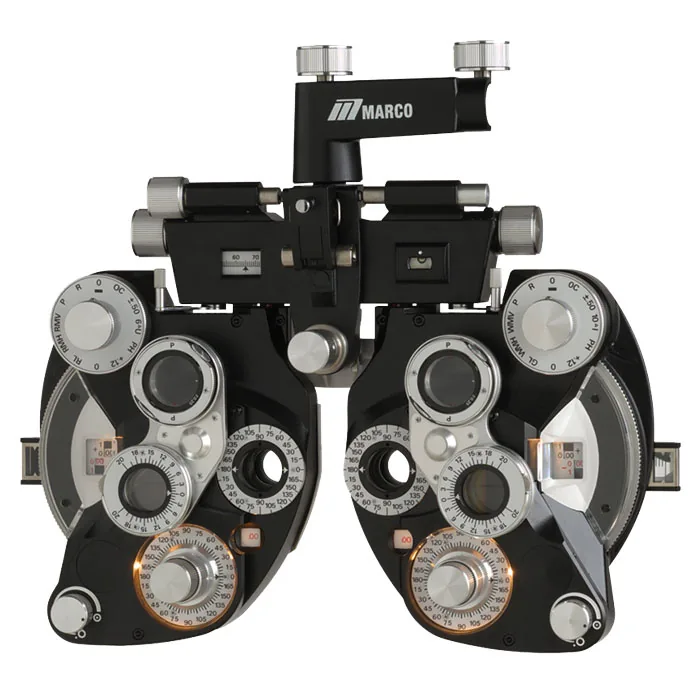
#5 · Marco RT-700 Manual Refractor (Marco)
Best for dark lanes on a conventional head: adjustable LED illumination of the sphere, cylinder and axis scales.
Marco's RT-700 pairs a traditional refractor layout with an LED system that gives infinitely adjustable illumination of the sphere, cylinder and axis readings, plus white prism, accessory and cross-cylinder scales that are easier to read in dim light. Marco lists sphere from +16.75D to -19.00D in 0.25D steps, cylinder 0.00 to ±6.00D (±8.00D with an additional ±2.00D lens), axis 0 to 180 degrees in 5-degree steps, a ±0.25D cross cylinder selectively synchronized with the axis, and 0 to 20Δ rotary prisms in 1Δ steps. PD adjusts from 48 to 75 mm, convergence from infinity to 400 mm, forehead rest by 16 mm, and vertex distance is 13.75 mm. The auxiliary dial covers open apertures, a +1.50D retinoscopic lens, polarizing lens, white and red Maddox rods in both orientations, red and green lenses, +0.12D sphere, pinhole, dissociating prisms, a fixed ±0.50D cross cylinder and an occluder. A wing-grip head design and knurled knobs aid handling, the unit weighs about 4.44 kg, and Marco quotes a 5-year limited warranty.
Pros: Infinitely adjustable LED scale illumination · High-contrast white scales · Comprehensive auxiliary lens dial · Wing-grip head for positioning
Considerations: PD range limited to 48 to 75 mm · LED system adds a powered component to a mechanical instrument
Best for: Practices that refract with the room fully darkened and want lit scales without moving to a digital head.
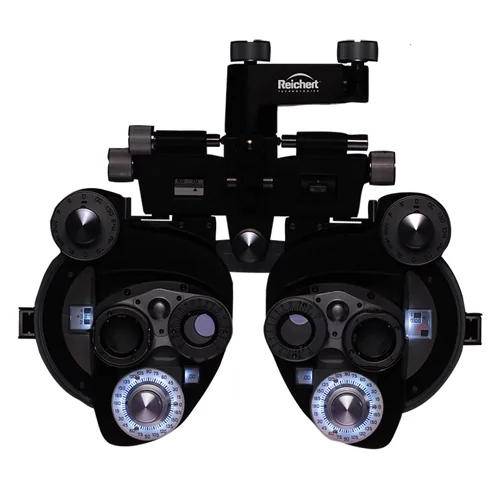
#6 · Reichert Illuminated Phoroptor (Reichert)
The classic Phoroptor mechanism with LED-lit dials for darkened exam rooms.
The Illuminated Phoroptor takes the Ultramatic RX Master platform and adds LED-lit sphere, cylinder power and cylinder axis scales. Reichert says the cool-running LEDs illuminate only the scales, use a patented design that needs no bulb changes, and run from a single illumination control, so you can refract without a pen light. Optical and mechanical specifications match the Ultramatic: sphere -19.00D to +16.75D in 0.25D steps with a +0.12D sphere in the auxiliary dial, cylinder 0.00 to 6.00D with 0.12D and 2.00D accessory cells, a double 0 to 180 degree axis scale in 5-degree graduations, a ±0.25D cross cylinder with optional ±0.37D and ±0.50D flip lenses, 0 to 20Δ geared rotary prism, PD 48 to 75 mm, a 13.75 mm normal vertex distance and a 5 to 28 inch reading distance. The auxiliary dial carries 10 lenses and 2 open apertures. It is available in plus or minus cylinder in black, and shares the Ultramatic's limited lifetime warranty program for original owners, subject to registration and periodic authorized service.
Pros: LED-lit scales with no bulbs to replace · Same geared prism and mechanics as the Ultramatic · Plus or minus cylinder · Limited lifetime warranty program
Considerations: Warranty conditions require regular authorized service · Black finish only in the catalog · Illumination adds a powered component
Best for: Reichert loyalists who want illuminated dials while staying with a manual instrument.
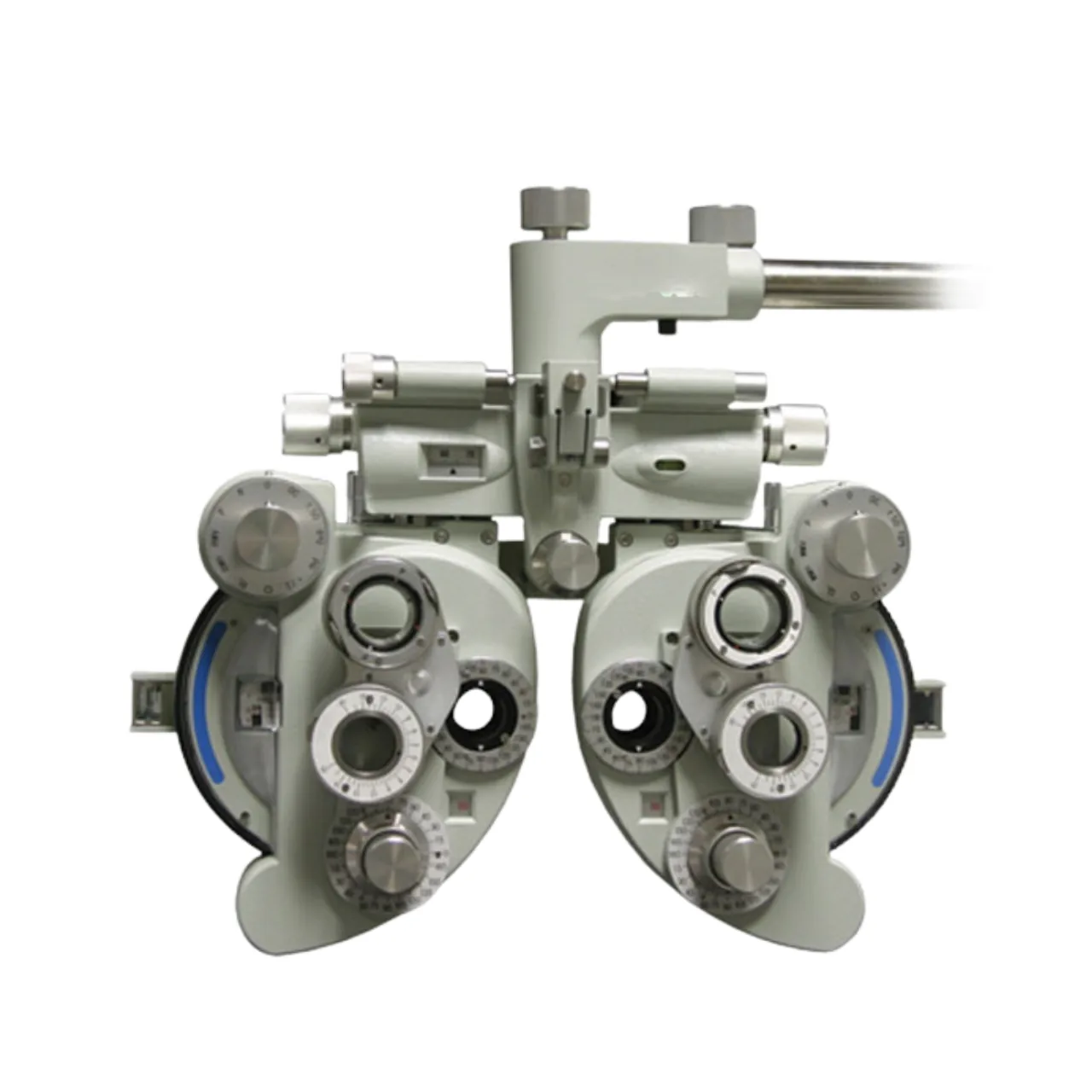
#7 · S4OPTIK SL-Y100 Refractor (S4OPTIK)
A no-frills minus-cylinder vision tester covering the standard refraction range.
S4OPTIK describes the SL-Y100 as a minus-cylinder vision tester built for smooth, comfortable operation. Its published refraction range runs from -19.00D to +16.75D in sphere, with cylinder to -8.00D when the accessory lens is used. Cross cylinders are synchronized with the axis, lenses are fully coated, and the head ships with what S4OPTIK calls a full complement of auxiliary lenses. Beyond those points, S4OPTIK's own product page publishes few detailed specifications, so buyers should request the spec sheet to confirm PD range, convergence distance, prism mechanics and weight before comparing it line by line with the other heads in this guide. S4OPTIK is based in Jacksonville, Florida. It suits buyers who want a conventional manual refractor and are comfortable confirming details directly with the manufacturer.
Pros: Standard sphere range with cylinder to -8.00D using accessory lens · Synchronized cross cylinders · Fully coated lenses
Considerations: Minus cylinder only on the published product page · Manufacturer page publishes limited detailed specifications
Best for: Budget-conscious lanes that need a basic minus-cylinder refractor and will verify full specs before ordering.
Feature comparison
| Model | Brand | Sphere range (standard) | Cylinder range | Rotary prism | PD range | Near convergence | Weight | Notable feature |
|---|---|---|---|---|---|---|---|---|
| ERF-5200 | Ezer | -19.00 to +16.75D, 0.25D steps | 0 to -6.00D (-8.00D with aux lens) | 0 to 20Δ, 1Δ steps, click stop | 50 to 75 mm | 380 mm (at 64 mm PD) | Approx. 5 kg | 3.00D fast-advance dial; black or white |
| Ultramatic RX Master Phoroptor | Reichert | -19.00 to +16.75D, 0.25D steps | 0.00 to 6.00D, plus or minus cyl | 0 to 20Δ, 1Δ, geared | 48 to 75 mm | — | — | Limited lifetime warranty program |
| R-2500 | Luxvision | -19.00 to +16.75D, 0.25D steps | 0 to -6.00D (-8.00D with aux lens) | 0 to 20Δ, 1Δ steps | 48 to 80 mm | 400 mm | 5 kg | Widest PD range; black or white |
| VT-10 | Topcon | -19.00 to +16.75D, 0.25D steps | 0 to -6.00D (-8.00D with accessory) | 20Δ-0-20Δ, 1Δ steps | 48 to 75 mm | 40 cm (at 64 mm PD) | 4.5 kg | Plus and minus cyl; black or light grey |
| RT-700 | Marco | +16.75 to -19.00D, 0.25D steps | 0.00 to ±6.00D (±8.00D with ±2.00D lens) | 0 to 20Δ, 1Δ steps | 48 to 75 mm | Infinity to 400 mm | Approx. 4.44 kg | Adjustable LED scale illumination |
| Illuminated Phoroptor | Reichert | -19.00 to +16.75D, 0.25D steps | 0.00 to 6.00D, plus or minus cyl | 0 to 20Δ, 1Δ, geared | 48 to 75 mm | — | — | LED-lit sphere, cylinder and axis scales |
| SL-Y100 | S4OPTIK | -19.00 to +16.75D | To -8.00D with accessory lens | — | — | — | — | Minus cylinder; coated lenses |
Why it’s our top pick
US Ophthalmic is a US-based ophthalmic equipment provider that manufactures its own Ezer line, including the ERF-5200, and also offers the Luxvision R-2500. Because the refractor, the technical team and the spare-parts department sit with the same company, you get one point of contact for quoting, setup questions, adjustments and parts over the life of the instrument. Every unit is sold new with a US warranty.
Pricing is quote-based, so you can bundle a refractor with the rest of a lane (chair and stand, chart, slit lamp) and ask about financing in the same request. If your doctors prefer a specific competitor head on this list, we still recommend comparing the published specifications side by side: on the core optical ranges, the ERF-5200 and R-2500 match the long-established names, and they add practical touches such as fast-advance sphere dials and, on the R-2500, a wider PD range.
Ready to spec your refractors?
Send us your requirements and our equipment specialists will come back with a configuration built around how your practice actually works — including availability and lead time. US Ophthalmic is a direct provider to eye care practices nationwide.
Frequently asked questions
What is the best manual phoropter in 2026? For most practices we rank the Ezer ERF-5200 first. It covers the standard -19.00D to +16.75D sphere and 0 to -6.00D cylinder ranges with auxiliary extensions, adds a click-stop rotary prism and one-lever convergence, and is supported directly by the provider that manufactures it. The Reichert Ultramatic RX Master is the best-known alternative if your doctors want the traditional Phoroptor feel.
Is a phoropter the same thing as a manual refractor? Yes. Phoropter (and Reichert's trademarked spelling, Phoroptor) is the common name for a refractor head. A manual refractor is changed by hand with knobs and dials, while a digital or automated refractor moves its lenses with motors controlled from a keypad or tablet.
Should I buy a plus-cylinder or minus-cylinder refractor? Match the convention your doctors refract in. Optometrists usually work in minus cylinder, while many ophthalmologists prefer plus cylinder. Reichert and Topcon list both versions; the Ezer, Luxvision and S4OPTIK models in this guide publish minus-cylinder ranges, so confirm availability when you request a quote.
What does the +0.12D auxiliary lens do? It lets you refine sphere or cylinder power in 0.12D increments instead of the standard 0.25D step, which is useful when a patient is sensitive to small changes near the endpoint of refraction.
How important is the PD range on a manual phoropter? It determines whether you can center the lenses for patients with very narrow or very wide interpupillary distances. Most heads here cover 48 to 75 mm; the Luxvision R-2500 extends to 80 mm, which helps with larger adult heads.
How do I maintain a manual refractor? Keep the lenses clean with methods the manufacturer approves, use face shields, cover the head when the lane is idle, and schedule periodic professional cleaning, lubrication and adjustment. Some warranties, such as Reichert's lifetime program, require documented service at set intervals.
Should I choose a manual or a digital phoropter? Manual heads are simpler, need no software or power for refraction (illuminated models aside), and are easy to service. Digital heads speed workflow and connect to EHR systems. If you are considering a digital head, see our separate digital phoropter guide.
The verdict
The Ezer ERF-5200 is our pick for the best manual phoropter in 2026: it delivers the full standard refraction range, a click-stop rotary prism, one-lever convergence and a fast-advance sphere dial, with manufacturing, service and parts handled by the same US provider. The Luxvision R-2500 is the value choice when you want built-in auxiliary lenses and the widest PD range in this guide.
Among competitors, the Reichert Ultramatic RX Master and its illuminated sibling remain the reference for feel and warranty commitment, the Topcon VT-10 is a dependable, conventional choice with a full auxiliary dial, and the Marco RT-700 is worth a look if lit scales matter in a dark lane. Request a quote for the ERF-5200 or R-2500 to compare configuration, accessories and delivery for your lanes.