
Surgical & examination headlights

A headlight puts bright, focused, shadow-free light exactly where a clinician is looking while keeping both hands free. In ophthalmic and optometric settings that matters for close examination, minor oculoplastic and lid procedures, contact and specialty-lens work, and precision tasks at the optical bench. Worn on a headband or clipped to surgical loupes, an LED headlight delivers coaxial, color-accurate illumination on the working field so fine tissue and instrument detail stay clearly visible without repositioning an overhead lamp.

US Ophthalmic supplies examination and surgical headlights to practices, surgery centers, and optical labs across the United States, backed by our in-house technical and repair department, readily available spare parts, and US warranty service. In this collection we carry the Neitz line of LED loupe illuminators, portable systems engineered to pair with binocular loupes and deliver consistent, high-quality light through long clinic days.

How to choose a surgical or examination headlight

  • Brightness and adjustable levels: Match output to the task. Detailed procedural and loupe work calls for a high-output LED, while routine exam use is comfortable at lower levels. Multi-step brightness control lets one headlight serve both without washing out the field or straining the eyes.
  • Battery system and runtime: Decide between a built-in rechargeable pack and swappable AA cells. A rechargeable pack is tidy and fast to top up between cases; user-replaceable Eneloop AA batteries let you carry spares and keep working through back-to-back clinics or a power outage. Check rated runtime at the high setting, not just the low one.
  • Weight and ergonomics: Comfort over a full day comes from where the mass sits. Designs that keep the head-worn body light and move the battery to a pocket or belt pack, connected by a flexible cord, reduce pressure on the nose and neck during extended wear.
  • Loupe and frame compatibility: For loupe users, confirm the illuminator mounts to your frame or headband and aligns coaxially with the magnified field so the light and your line of sight point at the same spot. The Neitz illuminators are built to integrate with their loupe frames and headbands.
  • Light quality and spot control: A clean, cool-white LED with good color rendering helps distinguish tissue and detail accurately. An adjustable illumination field lets you tighten the spot for pinpoint tasks or widen it for broader viewing.
  • Service, warranty, and spare parts: Batteries, charging cords, and chargers are consumables that wear over time. Buy from a provider that stocks those parts and services the unit domestically so a worn battery or frayed cord means a quick fix, not a dead headlight. Every unit here carries US warranty and in-house repair support.

The Neitz LED headlights we carry

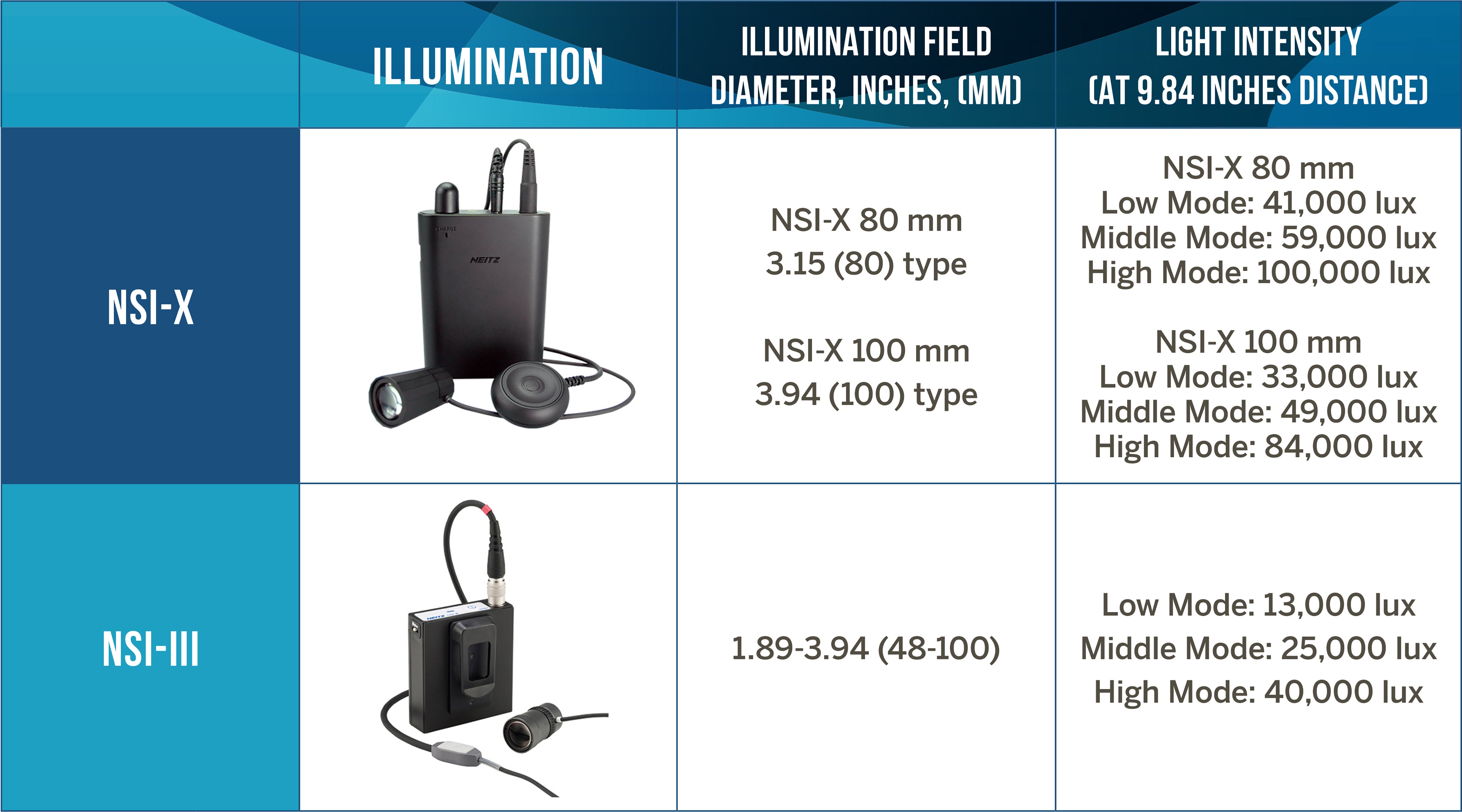
Both models are portable, cool-white LED loupe illuminators made in Japan by Neitz and designed to pair with binocular loupes. The practical difference comes down to their battery approach and output, summarized below.

ModelBattery systemBest for
NTZ-NSI-XBuilt-in rechargeable NiMH pack with fast rechargeHigher-output flagship illumination for demanding loupe and procedural work, and long sessions where a tidy rechargeable pack is preferred
NTZ-NSI-IIIUser-swappable Eneloop AA cells (also runs on standard AA)Clinics that value on-the-fly battery swaps, carrying spares, and emergency or backup readiness during power interruptions

Frequently asked questions

What is the difference between the Neitz NSI-X and NSI-III headlights? Both are cool-white LED loupe illuminators, but they differ in power source and output. The NSI-X is the higher-output flagship and uses a built-in rechargeable NiMH battery pack that tops up quickly between cases. The NSI-III runs on user-swappable Eneloop AA batteries, so you can carry charged spares and swap in seconds, and it will even run on standard AA cells in a pinch. Choose the NSI-X for maximum brightness and a self-contained rechargeable design, or the NSI-III for field-swappable batteries and backup readiness.

Can these headlights be used with surgical loupes? Yes. Both Neitz illuminators are engineered to pair with binocular loupes and mount to the corresponding frame or headband, aligning the light coaxially with the magnified field. This keeps the beam pointed exactly where you are looking through the loupes, which is the main reason clinicians choose a loupe-mounted headlight over an overhead lamp.

Are they suitable for both exam-room use and minor procedures? Yes. Multi-level brightness lets a single headlight cover routine examination at a comfortable output and step up to a brighter level for minor procedures, lid and oculoplastic work, or detailed bench tasks. Selecting the right level for each task also helps preserve battery runtime and reduce glare.

What about batteries, cords, and repairs down the line? Batteries, charging cords, and chargers are wear items on any LED headlight. Because we supply these through our own service department, replacement parts are available and repairs are handled in-house in the US rather than shipped overseas, so a worn battery or damaged cord is a quick fix. All units are covered by US warranty.

Should I buy a new headlight or consider a used one? For battery-powered headlights we recommend buying new. Illumination performance and runtime depend heavily on battery condition, and used units often arrive with degraded cells and no warranty coverage. New units ship with fresh batteries, full manufacturer specifications, and our US warranty and service support, which protects the reliability you need in daily clinical use. If you have specific budget or configuration needs, request a quote and our team will advise.

Request a Quote →