
















Lens Edge Polishers for In-Office Labs: How to Choose an Auto Polisher
How to choose a lens polisher for an in-office lab: when your edger's polish cycle is enough, flat vs bevel edges, lens materials, and AP-1000 vs AP-800.
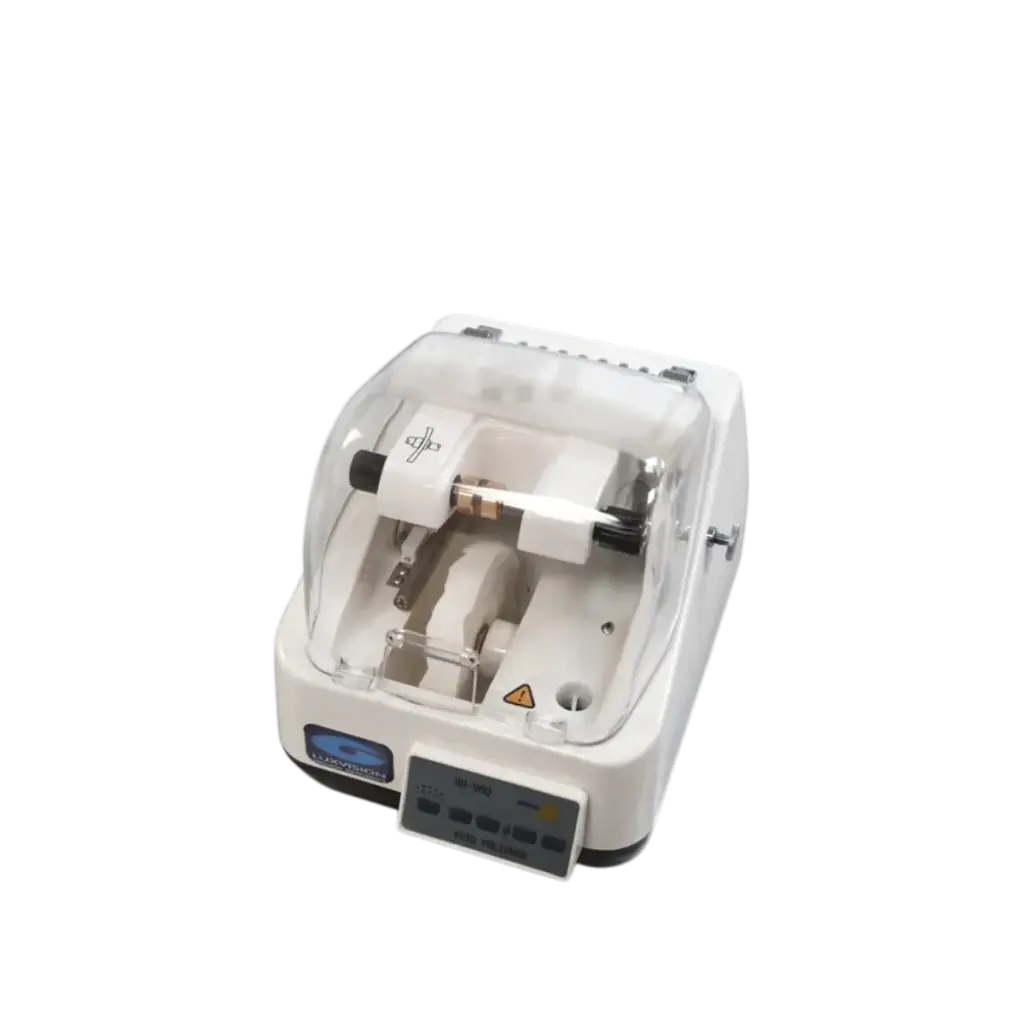
A lens polisher in an in-office finishing lab has one job: take a lens that has just come off the edger with a ground, frosted edge and give it a clear, finished edge before it goes into the frame. That sounds cosmetic, and on a full-rim acetate frame it mostly is. On a rimless drill-mount, a semi-rimless nylon-cord frame or a thick minus lens, the edge is part of what the patient sees every day — and a dull edge reads as an unfinished job. This guide covers how to decide whether you need a standalone optical lens polisher at all, what to compare between machines, and how the two auto polishers we supply, the Luxvision AP-1000 and AP-800, differ.
One scope note before we start. Search “lens polisher” and you will also find surfacing-lab polishers that finish the optical curves of freeform lenses, and polishers for contact lenses. Those are different machines for different labs. This article is about edge polishing after edging — the bench unit that sits next to the edger in an optometry practice or optical shop.
Shopping for Browse lens polishers? US Ophthalmic is a direct provider of Browse lens polishers to eye care practices across the US. Tell us how your lane is set up and we will come back with the configurations that fit, plus current availability and lead times.
Where an edge polisher sits in the finishing lab
Our in-office finishing lab guide walks through the full sequence: tracing, blocking, edging, then the finishing and mounting bench. Polishing is the step between the edger and the frame. That guide cites Optogrid’s finishing reference, which describes polishing with a felt or cotton buffing wheel as mandatory for rimless lenses and for high-index in any frame, and notes that on polycarbonate it removes the micro-fractures left by the grinding wheels.
The reason it matters is visibility. A 1990 US patent on machine edge polishing (US4908996) puts the problem plainly: in higher-power lenses, and in half, partial or rimless frames, at least part of the lens edge is exposed, so it was “particularly desirable for appearance sake” to give the edge a translucent rather than a frosted surface. Nothing about that has changed — rimless and semi-rimless frames still put the edge on display.
First question: is your edger’s polish cycle enough?
Many modern patternless edgers include a polishing wheel and a polish mode, so the first thing to check is the machine you already own. Our lens edger buying guide lists polishing among the standard finishing functions and calls it “cosmetic but decisive” on rimless and thin plastic frames. As an example, the iiNEER system we supply lists polishing as a processing mode alongside bevel, mini-bevel, rimless, grooving and chamfer.
Edge polishing inside the edger is not new — a 1990s patent (US5711700) describes edging and polishing polycarbonate, CR-39 and glass lenses on one machine with a single diamond polishing wheel. So why do labs still buy a standalone auto polisher? In practice, for one or more of these reasons:
- Your edger has no polish wheel. Entry-level and older edgers often skip it. A bench polisher adds the function without replacing the edger.
- Throughput. Every minute the edger spends polishing is a minute it is not cutting the next job. Moving polishing to a separate unit lets the edger stay on edging during busy hours.
- Touch-ups and retouches. A lens that has been retouched for size, or an edge that came out hazy, can be re-polished without re-chucking it in the edger.
- Drill-mount and custom work. Opticians finishing rimless jobs by hand often want a dedicated polishing station they can control directly.
If your edger already polishes and your volume is low, you may not need a second machine. If any of the points above describes your lab, a standalone lens edge polisher is usually the cheaper fix than upgrading the edger.
How to choose a lens polisher: the checklist
1. Lens materials and per-material modes
Your polisher has to handle the materials you actually dispense — typically CR-39 plastic, polycarbonate and high-index, plus the occasional mineral (glass) lens. Polycarbonate is the one to ask about. The US5711700 patent describes roughing polycarbonate substantially without coolant and running the polishing wheel dry before a wet pass, because polycarbonate does not behave like CR-39 under the wheel. A polisher with separate modes per lens type takes that guesswork away from the technician. Both Luxvision units list custom modes for plastic, mineral, polycarbonate and high-index lenses.
2. Edge profiles: flat, bevel and groove
Rimless lenses have a flat edge; full-rim lenses carry a V-bevel; semi-rimless lenses have a groove for the nylon cord. Polishing wheel profiles follow those shapes — the US4908996 patent illustrates one wheel with a small “V” for hide-a-bead lenses and a flat section for rimless, and another with a flat outer surface for rimless only. When you compare machines, ask which edge profiles the unit is designed to polish and whether the stick or wheel needs changing between them.
3. Control: computerized vs simple timer
At the bench, the main variable is how long each lens is polished. A built-in timer means the technician sets the cycle and walks away to mount the previous job. A computerized console adds programmed modes, which helps when several people share the lab and you want consistent results regardless of who is on shift.
4. Dust and debris control
Polishing produces fine debris and compound residue. Look for a vacuum hose connection and a dust cover — they keep the bench, and the frames waiting on it, clean. Both units we carry ship with a hose and vacuum adapter.
5. Consumables and wheel life
The polishing disc and compound are consumables. Ask what disc size the unit takes, whether replacement discs and polishing sticks are stocked in the US, and how often a lab at your volume replaces them. On a bench polisher, availability and turnaround of replacements matter more than any wheel-life claim.
6. Footprint, power and service
Measure the bench before you buy. Check the power supply rating matches your outlets, and confirm who services the unit and supplies parts once the warranty runs out. As an equipment provider with an in-house technical and spare-parts department, we cover service and warranty on the polishers we supply — ask for the terms when you request a quote.
Luxvision AP-1000 vs AP-800 compared
We carry two auto polishers, both from Luxvision and both listed in our lens polishers collection. They share a body size and weight; the differences are control and motor power.
| Specification | Luxvision AP-1000 | Luxvision AP-800 |
|---|---|---|
| Control | Computerized front-panel console | Built-in timer |
| Lens materials (per manufacturer) | Plastic, mineral, polycarbonate, high-index, with custom modes | Plastic, mineral, polycarbonate, high-index, with custom modes |
| Timer | 0–5 minutes | 0–5 minutes |
| Power consumption | 140 W | 80 W |
| Polishing disc | 4.5 in / 115 mm outer diameter (max) | 4.5 in / 115 mm outer diameter (max), 0.4 in / 10 mm thick |
| Dimensions | 8.42 x 10.7 x 9.45 in (214 x 270 x 240 mm) | 8.4 x 10.6 x 9.5 in (214 x 270 x 240 mm) |
| Net weight | 14.74 lb / 6.7 kg | 14.74 lb / 6.7 kg |
| Power supply | 110 V 50/60 Hz or 220 V 50 Hz | 110 V 60 Hz or 220 V 50 Hz |
| Included | Dust-proof cover, polishing compound applicator (stick), vacuum hose and adapter | Dust cover, polishing stick, hose and vacuum adapter |
Which one fits your lab? The AP-1000 is the choice when several technicians share the bench or you want console-programmed consistency across lens types, and its higher 140 W power rating suits a lab polishing a steady stream of jobs. The AP-800 covers the same materials and footprint with simple timer operation — a good fit for a smaller practice adding polishing to an edger that lacks it. Both fit the same bench space, so the decision is about workflow, not room.
Setting up the polishing station
- Place the polisher between the edger and the mounting bench so a lens moves in one direction.
- Connect the vacuum hose before the first job and keep the dust cover on between sessions.
- Keep spare polishing sticks or compound on the bench so a run never stops for consumables.
- Write the timer setting for each lens material on a card at the station so every technician polishes the same way.
- Inspect each edge under good light before mounting — a hazy edge is easier to fix before the lens is in the frame.
- Put the frame heater next to the polisher; our frame warmer guide covers choosing one for the same bench.
Next steps
If you are still choosing the edger itself, start with our patternless lens edger comparison and browse the lens edgers collection — whether your new edger polishes on its own changes whether you need a bench polisher. If you already know polishing is the gap, our team can help you match the AP-1000 or AP-800 to your volume. REQUEST QUOTE and ask about financing and service coverage.
Ready to spec your Browse lens polishers?
Send us your requirements and our equipment specialists will come back with a configuration built around how your practice actually works — including availability and lead time. US Ophthalmic is a direct provider to eye care practices nationwide.
Frequently asked questions
What does a lens edge polisher do?
It gives the edge of a freshly edged spectacle lens a clear, finished surface instead of the frosted surface left by the grinding wheels. It matters most on rimless and semi-rimless frames and thick lenses, where the edge is visible.
Do I need a separate polisher if my edger has a polish mode?
Not always. If your edger polishes and your volume is modest, its polish cycle may be enough. A standalone polisher earns its place when the edger has no polish wheel, when polishing slows the edger during busy periods, or when you want a station for retouches and hand-finished rimless jobs.
Can an auto polisher handle polycarbonate and high-index lenses?
Machines differ, so check the specification. Luxvision lists plastic, mineral, polycarbonate and high-index lenses for both the AP-1000 and AP-800, with custom modes for each lens type.
What is the difference between the Luxvision AP-1000 and AP-800?
The AP-1000 has a computerized front-panel console and a 140 W rating; the AP-800 runs on a built-in timer and is rated at 80 W. Both take a 115 mm polishing disc, share the same 214 x 270 x 240 mm footprint and weigh 6.7 kg.
Is a lens edge polisher the same as a surfacing polisher?
No. A surfacing polisher finishes the optical curves of a lens in a surfacing or freeform lab. An edge polisher finishes only the lens edge after edging, in a finishing lab.
Do you sell refurbished or used lens polishers?
No. US Ophthalmic sells new equipment, not refurbished or used units. If budget is the concern, ask our team about open-box availability and financing when you request a quote.