














Retinoscopy Equipment: Choosing a Streak Retinoscope and a Retinoscopy Rack or Bar
Choosing retinoscopy equipment? Compare streak vs spot heads, LED vs halogen, and retinoscopy racks, bars, trial lenses and phoropters for each lane.

Buying retinoscopy equipment is really two purchases: the instrument that throws the light (a streak or spot retinoscope) and the lenses you hold in front of the eye to neutralize the reflex (a retinoscopy rack, a skiascopy bar, loose trial lenses or the phoropter). This guide walks through both decisions for a retinoscopy rack and a streak retinoscope: what each part does, which specifications actually change your day in the lane, and how the options we carry compare. It is written for optometrists, ophthalmologists, orthoptists and the buyers who equip their rooms, not as a technique tutorial.
If you already know what you need, the full line-up is on our retinoscopes category page, and our team can configure a kit through the REQUEST QUOTE form.
Shopping for Browse retinoscopes? US Ophthalmic is a direct provider of Browse retinoscopes to eye care practices across the US. Tell us how your lane is set up and we will come back with the configurations that fit, plus current availability and lead times.
The two parts of a retinoscopy kit
Retinoscopy (also called skiascopy) uses light and lenses to locate the far point of the eye and put a number on it. The examiner watches the movement of the reflex in the pupil, then adds plus or minus lenses until the reflex is neutralized. That gives you a natural split in the shopping list:
- The retinoscope — head, sleeve and handle. It decides beam shape, how easily you rotate and focus the streak, how bright the reflex is, and how long you can work between charges or bulb changes.
- The lens delivery — the phoropter, a trial lens set, or a handheld rack or bar of graded lenses. It decides how fast you can move through powers and whether you can work away from the refracting unit.
Most practices need both a lane setup (retinoscope plus phoropter) and a portable setup (retinoscope plus rack or bar) for patients who cannot sit behind the phoropter. EyeWiki notes that this objective measurement does not depend on subjective responses, which is why it remains a mainstay for infants, young children and others who cannot cooperate with a subjective refraction.
Streak vs spot retinoscope: which head to buy
A spot retinoscope projects a round patch of light. A streak retinoscope uses a linear filament or source that projects a line. EyeWiki describes streak instruments as the more commonly used type today, because the line makes it easier to appreciate the linear reflex seen in astigmatism, and it points out that beam vergence cannot be altered on a spot retinoscope but can on a streak model. The streak design traces back to the Copeland retinoscope, patented in 1927.
| Question | Streak retinoscope | Spot retinoscope |
|---|---|---|
| Beam shape | A line you can rotate to scan each meridian | A round spot |
| Vergence control | Sleeve moves the source relative to the lens (divergent / convergent) | Not adjustable, per EyeWiki |
| Typical use today | The default for general and specialty practice | Still in use, mainly by examiners trained on it |
| What we carry | Ezer and Neitz streak models | No spot models currently listed |
For a new purchase, the practical answer is a streak retinoscope. If a senior clinician is trained on spot technique, that is a preference worth respecting, but it is the exception rather than the rule.
What to check on a streak retinoscope
Sleeve: rotation and vergence on one control
The sleeve sits below the optical head and controls both streak rotation (meridian) and streak focus (vergence). Sliding it changes the distance between the source and the lens to converge or diverge the light, and rotating it turns the streak around the meridians. Eyes On Eyecare describes the sleeve-down position as diverging light with a plane-mirror effect and sleeve-up as converging light with a concave-mirror effect, but EyeWiki notes that different sleeve positions are used for different techniques, so confirm the markings on the specific instrument before training staff on it. A sleeve that turns smoothly with one hand and holds its position is worth more than any headline spec.
Light source: halogen bulb or LED
This is where the carried models differ most:
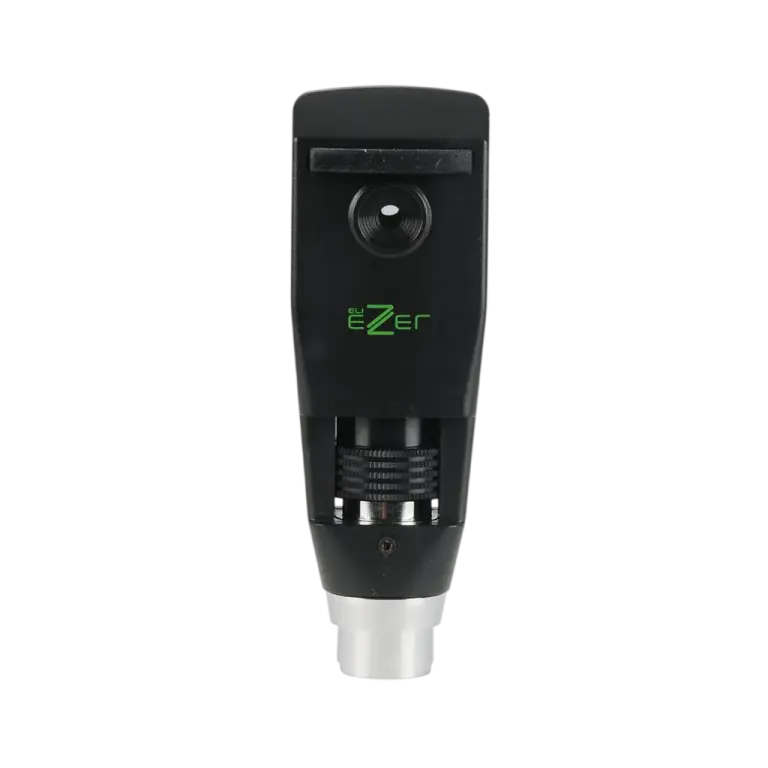
- The Ezer EZ-RET-2600 uses a 3.5 V, 2.7 W bulb. Its specification sheet lists intermittent operation: on-time should not exceed 2 minutes, with off-time of no less than 5 minutes.
- The Neitz NTZ-RET-RX-RC uses a halogen L-27 bulb (4 V, 2.6 W) and ships with a replacement bulb.
- The Neitz NTZ-RET-RX-RCUSB-LED uses an LED source (L-102), so there is no bulb to replace, and it offers normal and high brightness modes. Neitz states its LED light field is two to three times brighter than its traditional halogen models; maximum power consumption is listed at less than 2 W.
An LED head costs you nothing in bulbs and suits bright rooms or screening sites. A halogen head is the familiar choice and replacement bulbs are a small, predictable consumable. Either way, budget a spare bulb or a second handle for any room that runs back-to-back exams.
Power: battery chemistry and charging
- NTZ-RET-RX-RC: nickel-cadmium rechargeable battery (1000RS), illumination time listed at approximately 80 minutes. A desktop dual charger (NTZ-CHG-RC-II) is sold separately and charges two units at once.
- NTZ-RET-RX-RCUSB-LED: one lithium-ion battery (3.6 V nominal, 3200 mAh) with integrated safety circuits, USB charging.
- EZ-RET-2600: metal handle, and it can be bought as part of a kit with the Ezer direct ophthalmoscope head, handle, charger and case (Kit 1: EZ-OPH-3600, EZ-RET-2600, EZ-HND-2600, EZ-CHG-3600, EZ-OPH/RET-CASE).
If the retinoscope shares a handle system with your direct ophthalmoscope, one charger and one spare handle cover both heads. That is the main argument for buying the head as part of a kit.
Rotation range, weight and handling
The NTZ-RET-RX-RC lists continuous 360° beam rotation and a weight of approximately 580 g; the LED version lists approximately 285 g including its rechargeable battery, at the same 34 x 269 mm footprint. The EZ-RET-2600 lists rotation of at least 190°, a slit image at least 30 mm long and no more than 1.5 mm wide at focus, and a dustproof head with multilayer optics. Weight matters more than buyers expect: a lighter instrument is easier on the wrist across a full pediatric clinic.
Accessories that change the workflow
- Fixation cards. The EZ-RET-2600 includes four fixation cards that attach magnetically to the head, with age-appropriate symbols and words. Neitz offers an RX fixation card set as an optional accessory for the LED model. Cards on the head give the patient a near target, which is what dynamic retinoscopy relies on: EyeWiki describes it as an assessment made while the patient actively focuses on a near object, without lenses and without relaxing accommodation.
- Presbyopic lens. The NTZ-RET-RX-RC comes with a +2 D presbyopic lens fitted, with +1 D and +3 D lenses available as options; the LED version lists the +1 D and +3 D lenses as optional accessories.
- Brow / head accessory. Neitz includes a head accessory that keeps the retinoscope from touching the examiner’s glasses, a small detail that matters for spectacle wearers.
Retinoscopy rack, skiascopy bar, trial lenses or phoropter?
Once the reflex is visible, you need lenses to neutralize it. Eyes On Eyecare points out that retinoscopy can be done without a phoropter by using a lens rack or loose lenses, and that loose lenses or skiascopy bars are what you use for vision screenings and mission trips. The terms are used loosely in the trade: “retinoscopy rack”, “retinoscopy bar” and “skiascopy bar” all describe a handheld holder carrying a graded series of plus or minus lenses, so the examiner moves along the bar instead of swapping individual lenses.
| Lens delivery | Best fit | Trade-off |
|---|---|---|
| Phoropter | Routine adult exams in a fixed lane | Patient must sit behind the instrument; not portable |
| Trial lens set + trial frame | Fine-tuning, high powers, patients who cannot use a phoropter | Slower: each lens is inserted by hand |
| Retinoscopy rack / bar | Children, screenings, bedside and outreach work | Fixed power steps per bar; sphere only on most sets |
The rack and bar sets we carry
- Luxvision PRT-1000 retinoscopy bar set — bars of positive and negative spherical lenses (and, depending on the configuration, cylindrical lenses) mounted in a sturdy frame, so the reflex can be neutralized progressively without exchanging individual lenses.
- Luxvision RB-3000 — four hard plastic rails with five lenses each, in a wooden case measuring approximately 5″ x 13″ x 2½”.
- Luxvision RB-2000 — optical glass lenses (rather than resin) with large apertures that make it approachable for students and new examiners; the listed sphere steps run from 0.25 D to 5.00 D, supplied in a custom-fitted case.
When you compare sets, check three things on the product page or in your quote: the power range and step size per bar, whether the lenses are glass or plastic, and the aperture size. Large apertures are easier to keep centered on a moving child; glass resists scratching better in a bag that travels.
Do not forget the working distance
Whatever lens delivery you choose, the final number has the working distance taken off. EyeWiki gives the example of a 50 cm working distance, where 1/0.5 m, or 2.00 D, is subtracted from the neutralizing lens. A rack does not change that arithmetic, but it does change how consistent your working distance is when you are kneeling beside a pediatric patient, so train everyone who uses the kit on one standard distance.
Matching the kit to your practice
| Practice type | Retinoscope | Lens delivery |
|---|---|---|
| Primary-care optometry lane | Streak head on a shared ophthalmoscope handle (Ezer kit) | Phoropter, plus one bar set for children |
| Pediatric / orthoptic clinic | Lightweight LED streak head with fixation cards | Bar set as the primary tool, trial set for confirmation |
| School screening or outreach | LED head with USB-charged lithium battery | Compact bar set in a hard case |
| Teaching clinic | Several identical heads so students learn one sleeve layout | Large-aperture glass bars |
If you are also equipping the rest of the lane, our trial lens set and trial frame guide covers the lens set that sits alongside the rack, and our direct ophthalmoscope and retinoscope comparison ranks complete instruments head to head.
Care, storage and what to check on arrival
- On arrival: confirm the head, handle, charger, spare bulb (halogen models) and any fixation cards or presbyopic lenses listed on the quote are in the box. Check that the sleeve rotates and slides through its full range.
- Charging: charge with the charger specified for that handle. Neitz states the RX-RC should only be charged with the Neitz charger.
- Operating limits: the EZ-RET-2600 is specified for +10 °C to +35 °C and 30–75% relative humidity in use; respect the 2-minutes-on / 5-minutes-off duty cycle in long clinics.
- Racks and bars: store them in their case, lenses unstacked, and wipe them with the same lens-safe cloth you use for trial lenses. A scratched low-power lens is the one you will use most.
New or open-box?
We sell new instruments, not refurbished or used ones. If budget is the constraint, ask about open-box units — demo and display stock that is inspected and function-checked, with the warranty term stated per unit. For a retinoscope, the parts to ask about on any open-box unit are battery condition and bulb hours.
Ready to spec your Browse retinoscopes?
Send us your requirements and our equipment specialists will come back with a configuration built around how your practice actually works — including availability and lead time. US Ophthalmic is a direct provider to eye care practices nationwide.
Frequently asked questions
What is a retinoscopy rack?
A retinoscopy rack (also called a retinoscopy bar or skiascopy bar) is a handheld holder carrying a graded series of plus or minus lenses. You slide along it to neutralize the reflex instead of inserting individual trial lenses, which makes it the usual tool for children, screenings and work away from the phoropter.
Should I buy a streak or a spot retinoscope?
For most practices, a streak retinoscope. It is the more commonly used type today, the streak can be rotated to scan each meridian, and its vergence can be adjusted with the sleeve, which a spot retinoscope cannot do.
Is an LED retinoscope better than halogen?
Not universally. LED removes bulb replacement and Neitz rates its LED model brighter than its halogen models; halogen is the familiar light many examiners trained on, and bulbs are a small consumable. Choose on brightness needs, battery system and the handle you already own.
Do I still need a phoropter if I have a retinoscopy rack?
Usually yes. The rack covers patients and settings where a phoropter is impractical; the phoropter remains the efficient tool for routine adult exams in a fixed lane.
What comes with the Ezer EZ-RET-2600?
The EZ-RET-2600 streak retinoscope includes four magnetically attached fixation cards, and it can be ordered as part of a kit with the Ezer direct ophthalmoscope head, handle, charger and case. Ask for the kit configuration in your quote.
Do you sell refurbished retinoscopes?
No. US Ophthalmic sells new equipment and a rotating selection of open-box units that are inspected and function-checked.
Ready to equip a lane or a screening kit? Browse the retinoscopes collection or REQUEST QUOTE and tell us how many rooms, which handle system you already use, and whether you need a portable bar set.
Sources: EyeWiki, Retinoscopy; Eyes On Eyecare, Retinoscopy from A to Z; manufacturer specifications on the linked US Ophthalmic product pages (Ezer EZ-RET-2600, Neitz NTZ-RET-RX-RC and NTZ-RET-RX-RCUSB-LED, Luxvision PRT-1000, RB-3000, RB-2000).