














Best Trial Frames in 2026: Universal Trial Frames Compared
The Luxvision TF-70 is our top trial frame for 2026: five lenses per side, independent PD and full bridge adjustment. See how 7 frames compare.
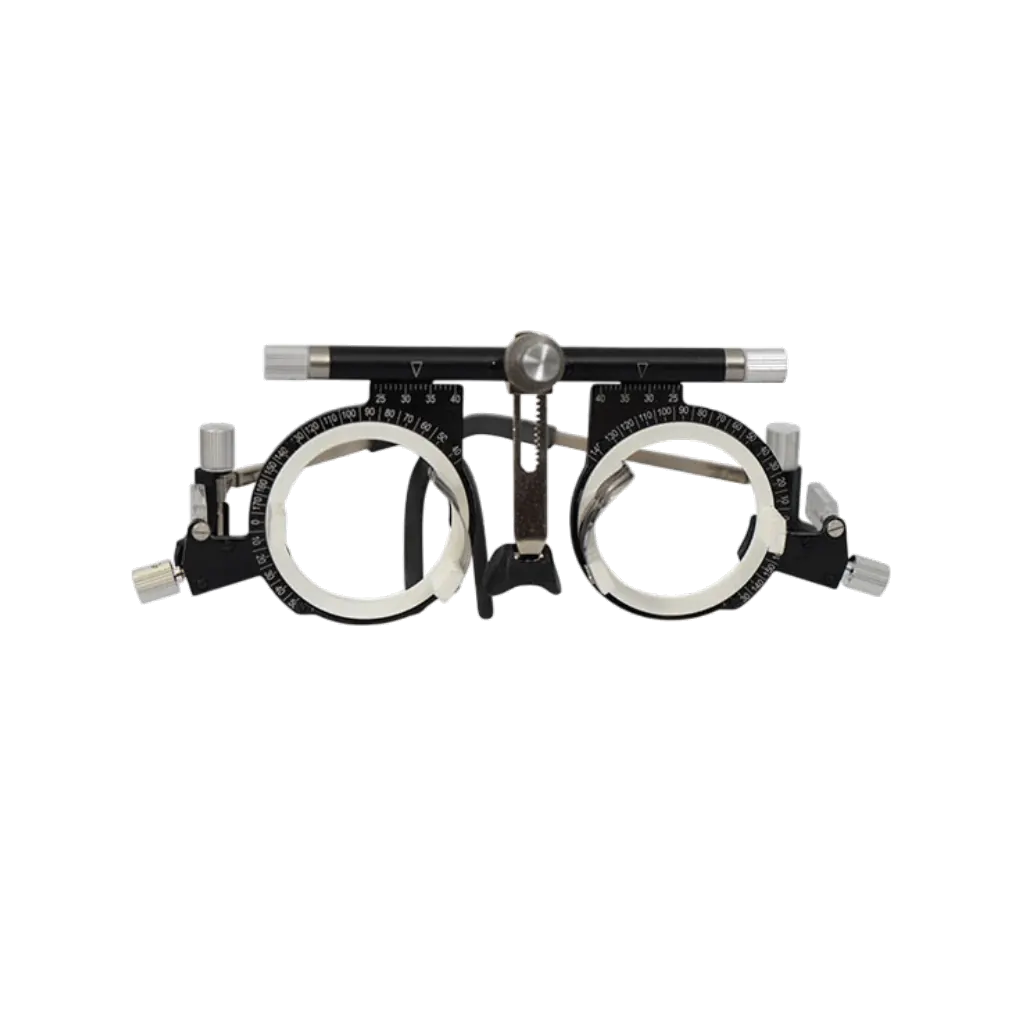
Our top pick for 2026 is the Luxvision TF-70 Trial Frame. It holds up to five trial lenses per side, adjusts left and right pupillary distance independently across a 50 to 80 mm binocular range, and lets you set bridge height, tilt, temple length and temple angle with knobs, all in a frame listed at 0.06 kg. For a practice that over-refracts, demonstrates prescriptions in the dispensary or checks high and complex corrections outside the phoropter, it covers the work without stepping up to a premium price tier.
A trial frame looks simple, but the details decide whether it gets used: how many lens slots you have per side, how wide the PD range is, how stable the axis scale stays while you rotate a cylinder, and how comfortably it sits on a patient for several minutes of walking around. Below we compare three Luxvision frames that US Ophthalmic carries with four well-known alternatives from OCULUS and Good-Lite, using only specifications published by each manufacturer or on our own product pages.
This guide is about trial frames only. Trial lens sets are a separate purchase and are covered in our trial lens guide; here we mention them only where lens size affects frame choice.
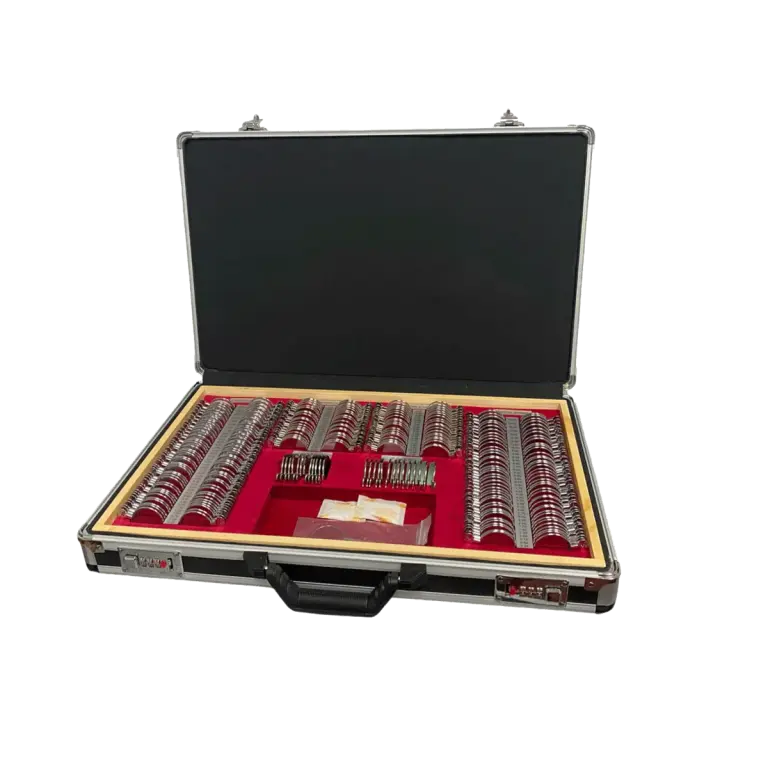
Shopping for trial lens set? US Ophthalmic is a direct provider of trial lens set to eye care practices across the US. Tell us how your lane is set up and we will come back with the configurations that fit, plus current availability and lead times.
How to choose a trial frame
- Lens slots per side: Count the cells in front and behind on each side. Four is enough for most sphere, cylinder and prism combinations; five or six gives room for an occluder, a pinhole or an auxiliary lens without removing your Rx lenses.
- PD range and scale: Check the binocular PD range and whether each side adjusts independently. A wide range (roughly high 40s to 80 mm) covers most adults; narrow-range frames such as 54 to 70 mm are lighter and simpler but will not fit every face.
- Axis scale and rotation: Look for a clearly printed axis scale on each cell and a smooth knob to rotate cylinders after insertion. The scale increment (5 degrees or 2.5 degrees) affects how finely you can set and read the axis.
- Fit adjustments: Nose bridge height and angle, temple length and temple tilt determine whether the lens plane sits square and at a sensible vertex distance. Frames without bridge or temple adjustment are faster but less exact.
- Vertex distance reading: For higher powers, a vertex distance (VD/CVD) scale helps you record or compensate for lens-to-eye distance. Not every frame publishes one.
- Weight and comfort: Most quality frames weigh roughly 47 to 65 g empty. Soft ear rests and well-placed controls matter more once four or five lenses are loaded.
- Lens compatibility and support: Confirm the frame accepts the rim diameter of your trial lens set, and that spare parts and service are available from the company you buy from.
#1 · Luxvision TF-70 Trial Frame (Luxvision)
Best overall: five lenses per side and full knob-based adjustment in a light frame.
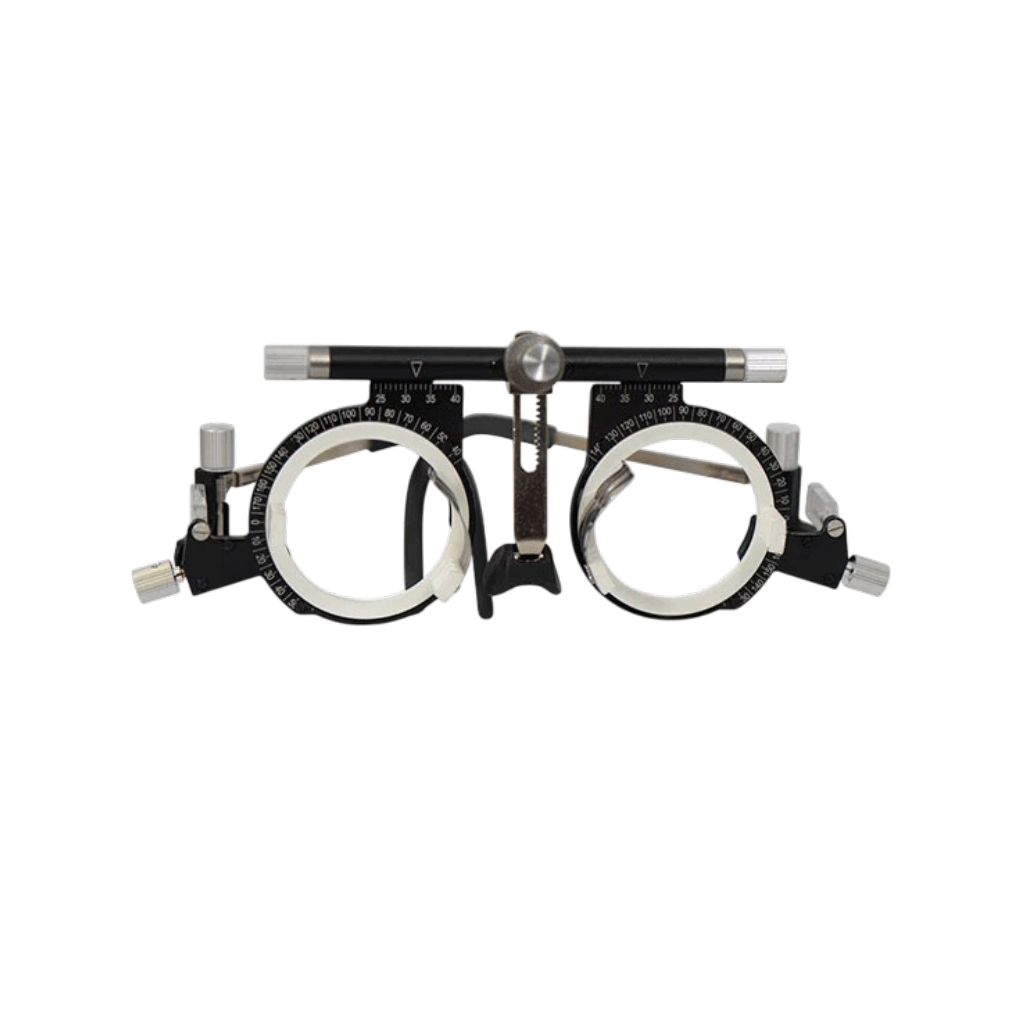
The TF-70 is the most capable frame in the Luxvision range that US Ophthalmic carries, and our first choice for most exam lanes and dispensaries. Each side has five lens supports, so you can stack sphere, cylinder and prism and still have a cell free. Left and right PD adjust independently from 25 to 40 mm per side (50 to 80 mm binocular) on a 1 mm scale, with a published PD tolerance of plus or minus 0.5 mm. Each disc carries an axis scale in 5 degree steps and lenses rotate a full 360 degrees, with an astigmatic axis knob to turn a cylinder after it is seated. Fit is handled by knobs for bridge height and tilt, a nasal pad with up to 23 mm of length adjustment, and adjustable temple length and temple angle. Soft ear rests help on longer over-refractions. The listed weight is 0.06 kg and the inner lens frame diameter is 34.5 mm. Because US Ophthalmic carries Luxvision directly, the frame is backed by our in-house technical and spare-parts departments and a US warranty, which matters for a tool that gets handled dozens of times a day.
Pros: Five lens supports per side · Independent left and right PD, 50 to 80 mm binocular · Knob adjustment for bridge height, tilt, temple length and angle · 360 degree lens rotation with axis knob · Soft ear rests · US warranty and in-house spare parts from US Ophthalmic
Considerations: No published vertex distance scale · Axis scale in 5 degree steps rather than finer gradations · More controls to set than a fixed-bridge frame
Best for: Practices that want one frame for over-refraction, complex prescriptions and dispensary demonstrations.
#2 · Luxvision TF-40 Trial Frame (Luxvision)
Best value full-adjustment frame, with the widest PD range of our Luxvision models.
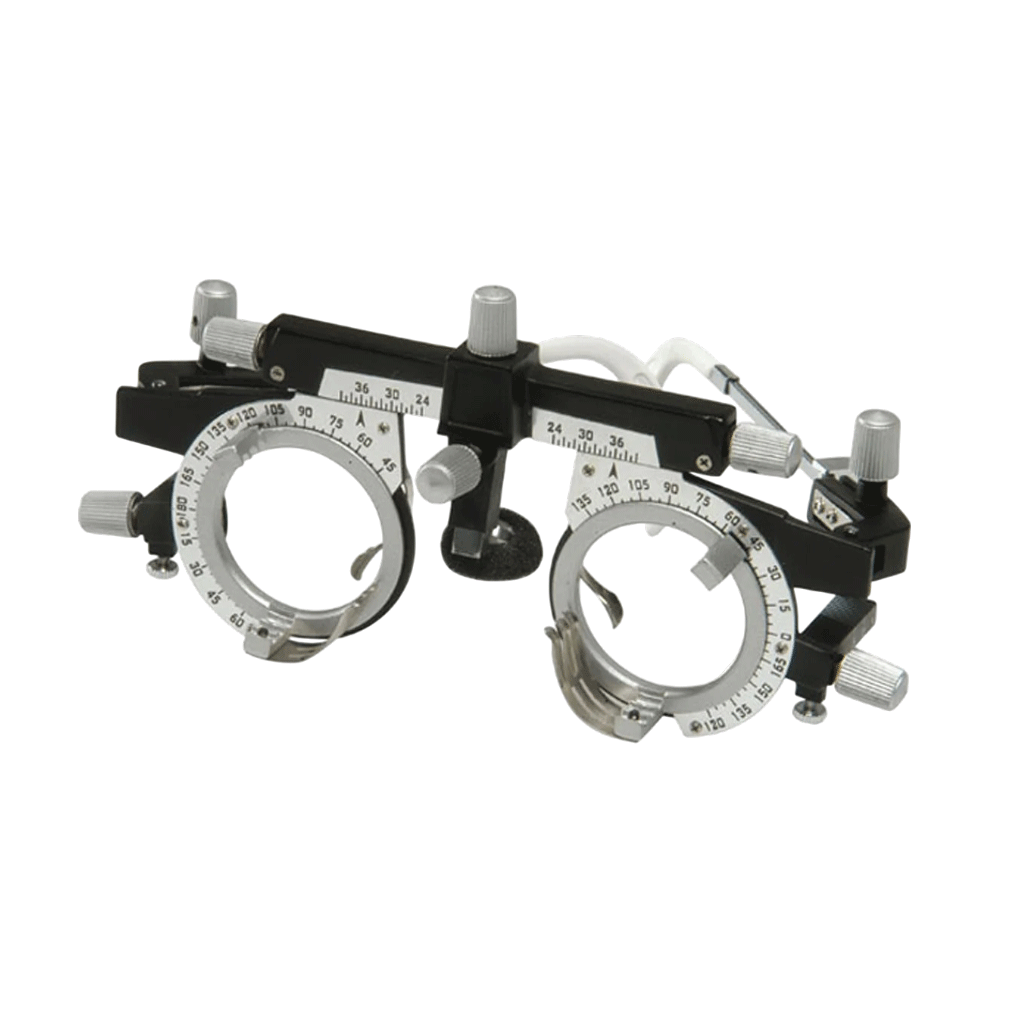
The TF-40 gives up one lens slot to the TF-70 but keeps nearly every adjustment, which makes it a strong value choice for second and third exam lanes. It holds up to four lenses on each side. PD adjusts on both sides, from 24 to 40 mm per side, for a binocular range of 48 to 80 mm on a 1 mm scale with a stated tolerance of plus or minus 0.5 mm. Each disc has an axis scale in 5 degree steps and lenses rotate 360 degrees, with an astigmatic axis knob for cylinders. Temple rods adjust from 98 to 135 mm, and an angle knob at each hinge lets you tilt the ear rests so the frame sits at approximately 15 degrees. The nasal pad adjusts in length (0 to 14 mm) and angle (0 to 30 degrees). The listed weight is 0.07 kg and the inner lens frame diameter is 32.5 mm. Soft ear supports and padded rests keep it comfortable during longer trial wear. Like all Luxvision frames from US Ophthalmic, it is supported by our technical and spare-parts teams.
Pros: Four lens supports per side · Widest PD range of the three Luxvision frames (48 to 80 mm) · Temple length 98 to 135 mm plus temple angle adjustment · Nasal pad length and angle adjustment · Soft ear supports
Considerations: One fewer lens slot per side than the TF-70 · No published vertex distance scale · Slightly heavier than the TF-70 per the listed specs
Best for: Additional exam lanes and optical dispensaries that want full adjustment at a value price point.
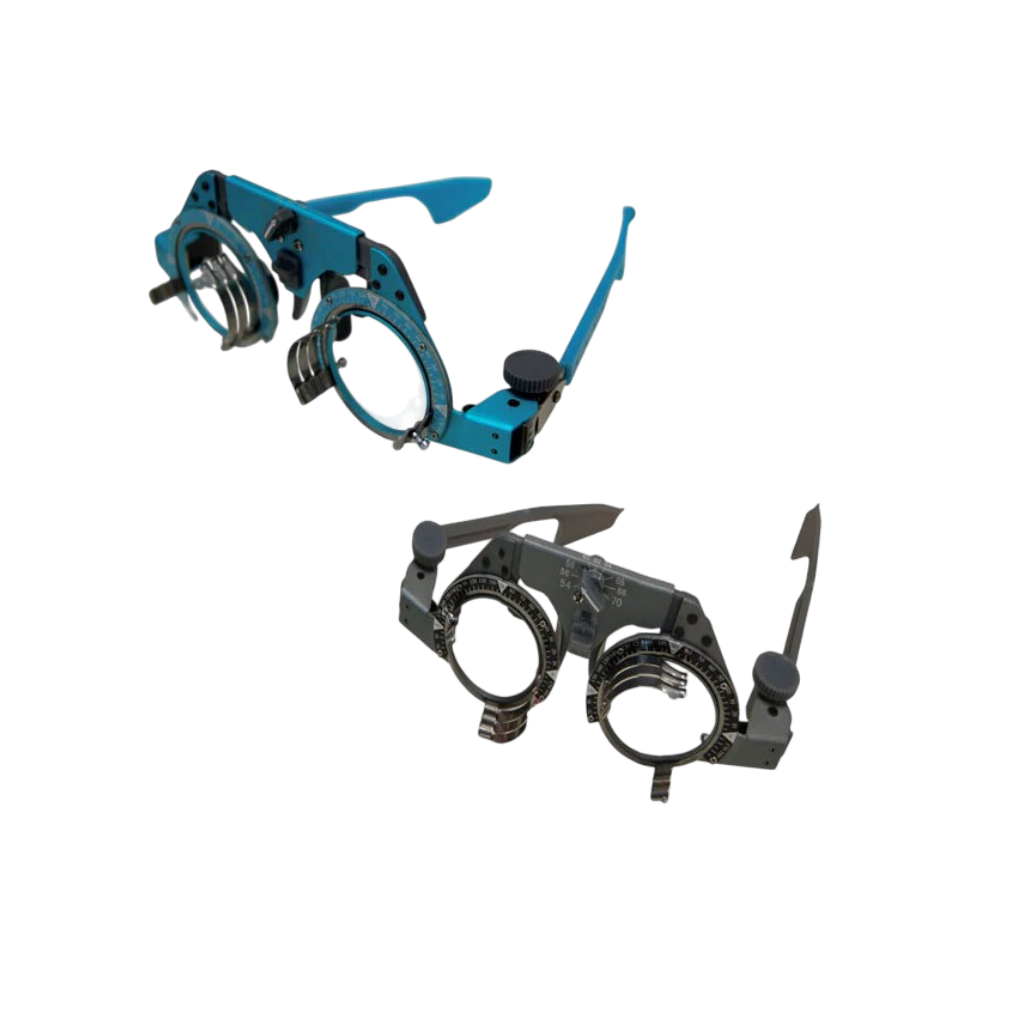
#3 · Luxvision TF-35 Trial Frame (Luxvision)
Lightest Luxvision option, quick to fit for routine adult patients.
The TF-35 is built for speed and low weight. Its aluminum construction brings the listed weight to 47 g, the lightest frame in this comparison, and it is designed to need fewer adjustments to reach a comfortable fit. It accommodates up to four 38 mm (1.5 in) trial lenses per side. The PD scale runs from 54 to 70 mm, which covers a large share of adult patients but not very narrow or very wide faces, so it pairs well with a wider-range frame elsewhere in the practice. You still get temple length and temple angle adjustment (with the ear rests set to roughly 15 degrees of tilt), nose pad height and width adjustment, a soft ear rest, and an astigmatic axis knob to rotate cylindrical or prismatic lenses once inserted. It is offered in blue and silver. For student kits, satellite offices or a dispensary demo frame, the TF-35 is an easy, durable choice, with service and spare parts available through US Ophthalmic.
Pros: Lightest frame here at 47 g · Aluminum construction · Holds four 38 mm trial lenses per side · Temple, nose pad and axis adjustments · Blue and silver options
Considerations: Narrower 54 to 70 mm PD range · No published axis scale increment or vertex scale · Fewer specifications published than the TF-40 and TF-70
Best for: Students, satellite clinics and dispensaries that want a light, quick-fitting frame for typical adult PDs.
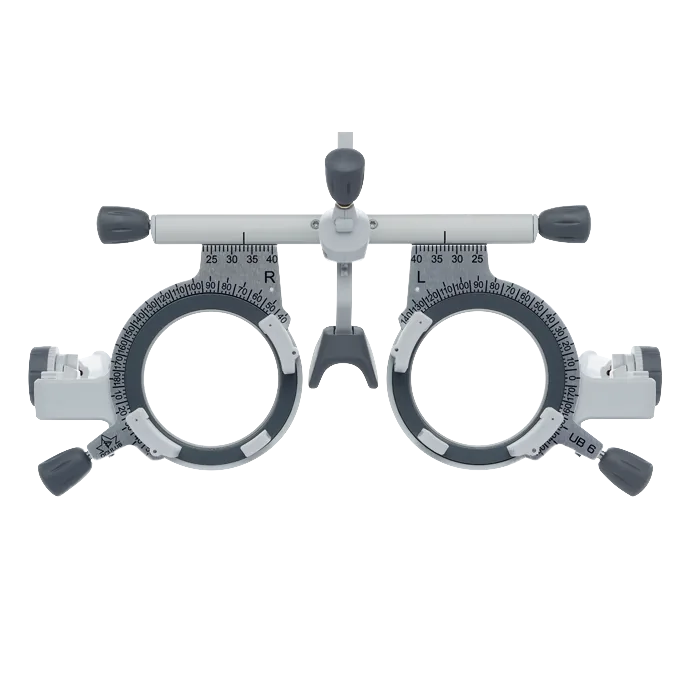
#4 · OCULUS Universal Trial Frame UB 6 (OCULUS)
The premium German frame, with six slots per side and a vertex distance scale.
The UB 6 is OCULUS's newest-generation universal trial frame and is widely regarded as a benchmark. Each side has six slots, four in front and two behind, and the front holder rotates through 360 degrees. OCULUS lists a PD range of 46 to 80 mm, an axis scale in 2.5 degree gradations, arm length of 92 to 130 mm and arm tilt of plus 12 to minus 14.5 degrees. A vertex distance measuring range of 3 to 14 mm is built in. The nose piece was redesigned with height and depth adjustment, and the published weight is 60.2 g. It accepts trial lenses to DIN EN ISO 9801 with a 38 mm rim diameter, such as OCULUS tl lenses, and OCULUS states the frames are assembled by hand in Germany and contain no latex. Optional clip-on linear or circular polarizing filters are available. It is an excellent frame; the trade-off is that it sits in a higher tier than the Luxvision models, and service runs through the company you buy from.
Pros: Six slots per side (4 front, 2 rear) · 2.5 degree axis gradation · Vertex distance range 3 to 14 mm · Height and depth adjustable nose bridge · Optional clip-on polarizing filters
Considerations: Premium tier compared with the Luxvision frames · Requires 38 mm rim lenses to DIN EN ISO 9801 · Not carried by US Ophthalmic
Best for: Refraction-heavy practices and binocular vision work that need maximum slots and fine axis control.
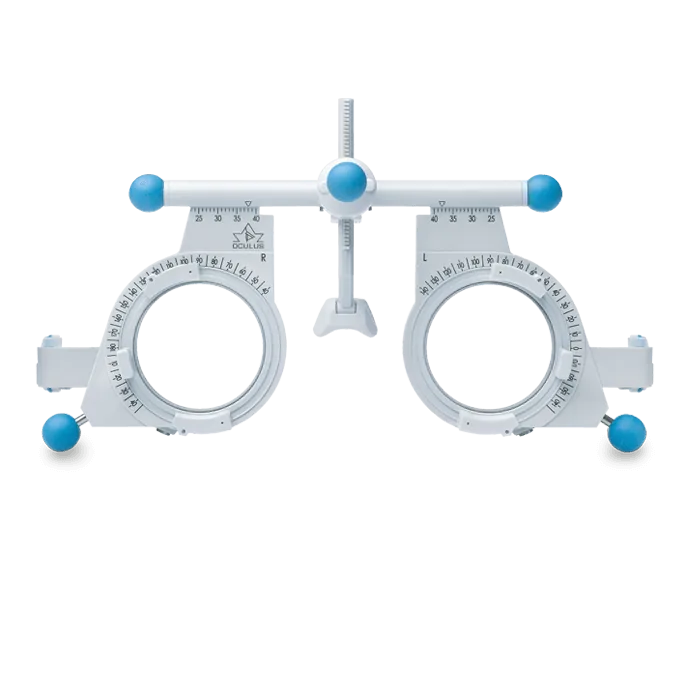
#5 · OCULUS Universal Trial Frame UB 4 (OCULUS)
The proven all-rounder that many other brands resell under their own names.
The UB 4 has been a reference trial frame for years, and its design shows up in other catalogs: Keeler's current UK range, for example, lists the OCULUS UB4 rather than a Keeler-designed adult frame. It has three slots in front and two behind on each side, ten in total, for 38 mm rim trial lenses to DIN EN ISO 9801. OCULUS lists a PD range of 46 to 78 mm, adjustable temple tilt and length, smooth axis adjustment, a CVD scale for reading vertex distance and a self-braking nose bridge adjustment. Controls sit away from the patient's face, the closed temple design keeps hair from catching, and the mixed-material ear pieces can be shaped to the patient. OCULUS gives the weight as approximately 64 g and states the frame is latex-free and hand-assembled. A slip-on polarizing filter with near and distance settings is optional. Like the UB 6, it is a premium-tier purchase, and parts and service come through the selling company.
Pros: Five slots per side (3 front, 2 rear) · CVD (vertex distance) scale · Self-braking nose bridge · Ergonomic controls set away from the face · Optional slip-on polarizing filter
Considerations: Premium tier compared with the Luxvision frames · Heaviest frame here with a published weight (about 64 g) · Not carried by US Ophthalmic
Best for: Practices standardizing on OCULUS lens sets that want a durable, familiar frame.
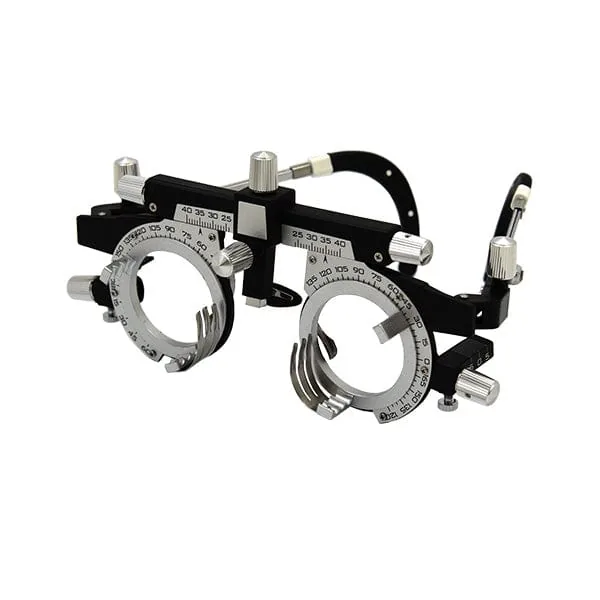
#6 · Good-Lite Universal Adult Trial Frame (455400) (Good-Lite)
A familiar US catalog frame with a full adjustment set and vertex scale.
Good-Lite's Universal Adult Trial Frame is a common choice in US schools and clinics. It accepts up to three 38 mm trial lenses in front of each eye and one behind, for four positions per side, and each lens position rotates through 360 degrees with printed scales and left and right axial calibration markings. PD adjusts from 48 to 80 mm total, or 24 to 40 mm per side. Good-Lite lists temple length adjustment of 98 to 135 mm, temple angle adjustment, nose bridge height of 0 to 14 mm and nose angle of 0 to 30 degrees, plus a built-in vertex distance scale. Trial lenses are not included. It is a solid, widely available frame; compared with the Luxvision TF-40 it adds a published vertex scale, while the TF-40 offers soft ear supports and comes with US Ophthalmic's in-house service. Buyers should note Good-Lite publishes a single weight figure that appears to be a shipping weight, so we have not compared weight.
Pros: Four lens positions per side (3 front, 1 rear) · PD 48 to 80 mm, independent per side · Built-in vertex distance scale · Temple length, temple angle, nose height and angle adjustment
Considerations: Only one rear cell per side · Published weight figure not useful for comparison · Not carried by US Ophthalmic
Best for: Clinics and training programs that buy from catalog suppliers and want a standard adjustable frame.
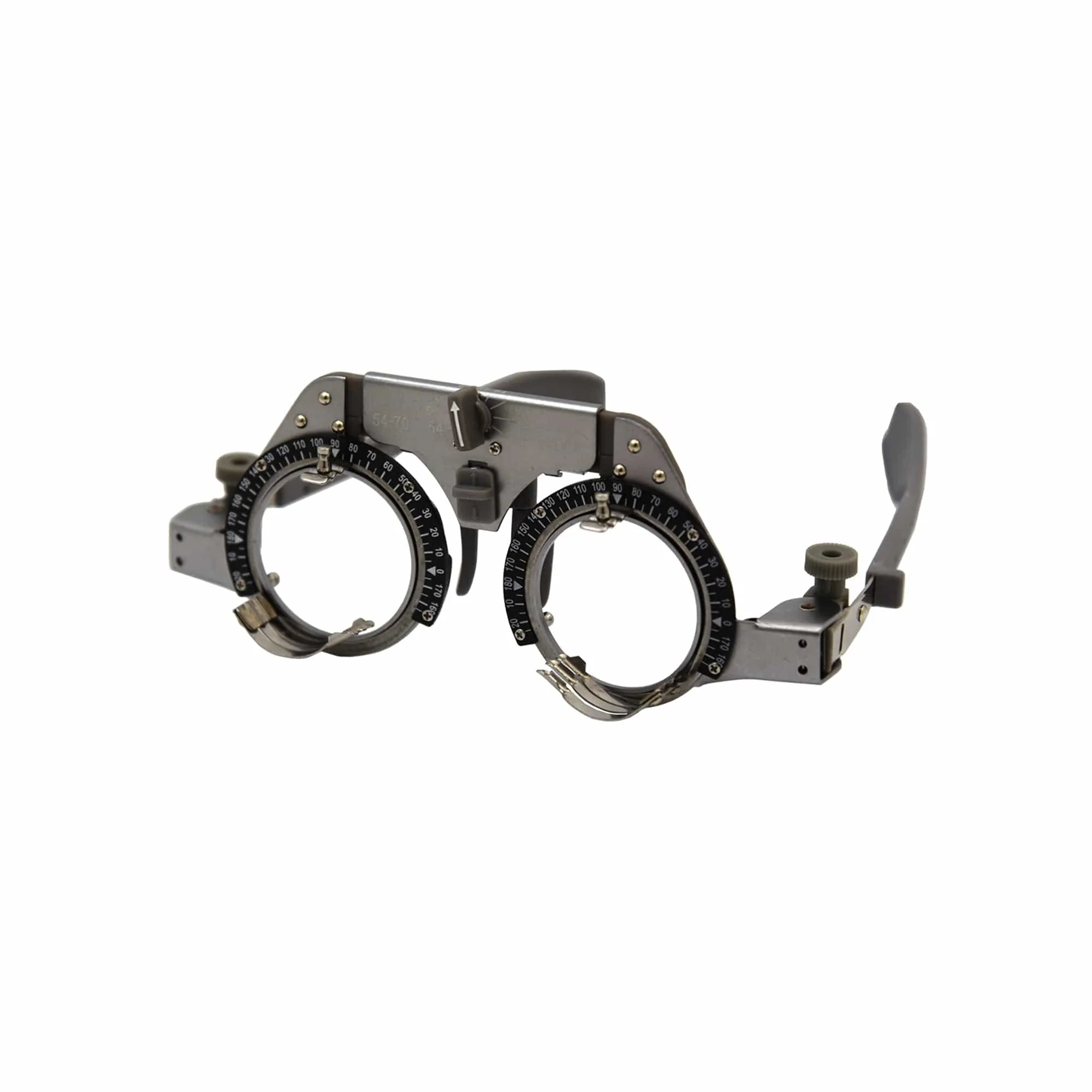
#7 · Good-Lite Titanium Universal Trial Frame (469900) (Good-Lite)
A spring-hinged titanium frame for quick fits within a mid-range PD.
Good-Lite's Titanium Universal Trial Frame targets the same quick-fit role as the Luxvision TF-35. It uses a lightweight, spring-hinged titanium frame, holds up to four 38 mm trial lenses per side and adjusts PD from 54 to 70 mm. Good-Lite highlights astigmatism axis adjustment and a one-touch nose pad for fast fitting, and positions it for both pediatric and adult patients. The spring hinges are a practical touch for frames that are put on and taken off all day. The limitations are the same as other narrow-range frames: patients outside 54 to 70 mm need a different frame, and Good-Lite publishes fewer detailed specifications (axis scale increment, temple range, vertex scale) than OCULUS or the Luxvision TF-40 and TF-70. Its listed weight is a single 0.3 kg figure that appears to be a shipping weight, so we have not compared it.
Pros: Titanium construction with spring hinges · Four 38 mm lenses per side · One-touch nose pad · Positioned for pediatric and adult use
Considerations: Narrow 54 to 70 mm PD range · Few detailed specifications published · Not carried by US Ophthalmic
Best for: Busy screening or dispensing settings that need a fast, durable frame for typical PDs.
Feature comparison
| Model | Brand | Lens slots per side | PD range | Axis scale step | Vertex scale | Weight (published) | Carried by US Ophthalmic |
|---|---|---|---|---|---|---|---|
| TF-70 | Luxvision | 5 | 50 to 80 mm (25 to 40 per side) | 5° | — | 0.06 kg | Yes |
| TF-40 | Luxvision | 4 | 48 to 80 mm (24 to 40 per side) | 5° | — | 0.07 kg | Yes |
| TF-35 | Luxvision | 4 | 54 to 70 mm | — | — | 47 g | Yes |
| UB 6 | OCULUS | 6 (4 front, 2 rear) | 46 to 80 mm | 2.5° | Yes, 3 to 14 mm | 60.2 g | No |
| UB 4 | OCULUS | 5 (3 front, 2 rear) | 46 to 78 mm | — | Yes (CVD scale) | approx. 64 g | No |
| Universal Adult 455400 | Good-Lite | 4 (3 front, 1 rear) | 48 to 80 mm (24 to 40 per side) | — | Yes | — | No |
| Titanium Universal 469900 | Good-Lite | 4 | 54 to 70 mm | — | — | — | No |
Why it’s our top pick
US Ophthalmic carries the Luxvision TF-70, TF-40 and TF-35 directly, so a trial frame bought from us is supported by the same in-house technical department and spare-parts department that service our larger equipment, and new frames come with a US warranty. That matters for a small instrument that takes constant handling: knobs, nose pads and ear rests are the parts that wear, and having a single US provider to call keeps lanes running.
The OCULUS frames are excellent and set the standard for slot count and fine axis control, and Good-Lite's frames are reliable catalog staples. Where the Luxvision line stands out is the balance of features to cost: the TF-70 matches the UB 4's five-slot capacity and the TF-40 matches Good-Lite's adjustment set, while all three are quote-based through US Ophthalmic alongside the rest of your exam-room equipment.
Ready to spec your trial lens set?
Send us your requirements and our equipment specialists will come back with a configuration built around how your practice actually works — including availability and lead time. US Ophthalmic is a direct provider to eye care practices nationwide.
Frequently asked questions
What is the best trial frame for an optometry practice in 2026? For most practices we recommend the Luxvision TF-70: five lens supports per side, independent PD from 50 to 80 mm, and knob adjustment for bridge height, tilt, temple length and angle. If you need six slots per side and a 2.5 degree axis scale for heavy binocular vision work, the OCULUS UB 6 is the premium alternative.
How many lens slots does a trial frame need? Four per side handles most sphere, cylinder and prism combinations. Five or six gives room for an occluder, pinhole or auxiliary lens without removing the prescription lenses, which helps with complex or high corrections.
What PD range should a universal trial frame cover? A universal adult frame should cover roughly the high 40s to 80 mm. The TF-40 (48 to 80 mm), TF-70 (50 to 80 mm) and OCULUS frames (from 46 mm) do; narrow-range frames like the TF-35 and Good-Lite Titanium (54 to 70 mm) are lighter and quicker but will not fit every patient.
Do trial frames come with trial lenses? Usually not. Frames such as the Good-Lite Universal Adult are sold without lenses, and lens sets are purchased separately. Check that the frame accepts the rim diameter of your lens set; OCULUS frames, for example, take 38 mm rim lenses to DIN EN ISO 9801.
Why does a vertex distance scale matter on a trial frame? At higher powers, the distance between the trial lens and the eye changes the effective power. A built-in vertex scale, as on the OCULUS UB 4 and UB 6 and the Good-Lite Universal Adult, lets you read and record that distance so the final prescription can be compensated.
What is the difference between the Luxvision TF-70, TF-40 and TF-35? The TF-70 holds five lenses per side with a 50 to 80 mm PD range; the TF-40 holds four per side with the widest range (48 to 80 mm) and published temple and nasal pad ranges; the TF-35 is the lightest at 47 g, aluminum, with a 54 to 70 mm PD range for quick fits.
Can I get service and spare parts for a trial frame in the US? For the Luxvision frames, US Ophthalmic has an in-house technical department and spare-parts department, and new frames come with a US warranty. For other brands, OCULUS directs buyers to the company they purchased from for spare parts.
The verdict
The Luxvision TF-70 is our top trial frame for 2026 because it combines five lens slots per side, independent PD across 50 to 80 mm and full knob-based fit adjustment in a 0.06 kg frame, with US Ophthalmic's service behind it. The TF-40 is the value pick with the widest PD range of the three, and the TF-35 is the light, quick-fit option for typical adult PDs.
If your work leans heavily on binocular vision testing and you want six slots per side, a 2.5 degree axis scale and a built-in vertex range, the OCULUS UB 6 is the premium benchmark, with the UB 4 as its proven predecessor. Good-Lite's Universal Adult and Titanium frames are dependable catalog options. Whichever you choose, match the frame to your trial lens set's rim diameter, and request a quote from US Ophthalmic to equip every lane with a frame and support plan that fits.