














Best Ultrasound Pachymeters in 2026
Our top ultrasound pachymeter for 2026 is the Ezer EUS-1800 P. Compare it with Reichert iPac, DGH Pachmate 2, Pachette 4, PachPen and FastPach.

Our top pick for 2026 is the Ezer EUS-1800 P. It pairs a 20 MHz pachymetry probe (straight or angled) with a color touch screen, corneal thickness maps, a built-in thermal printer and storage for 180 patient records, and it is sold, serviced and supported in the US by US Ophthalmic’s own technical and spare-parts teams. If you want one pachymeter that handles glaucoma CCT checks, refractive surgery screening and keratoconus follow-up from the same cart, it is the most complete package in this guide.
A pachymeter measures corneal thickness, most often central corneal thickness (CCT). Practices rely on it to put applanation IOP readings in context, to screen refractive surgery candidates, to follow corneas with suspected ectasia and to plan limbal relaxing incisions. Ultrasound pachymetry remains widely used for these tasks because it is compact, fast and does not need a large imaging platform.
Below we compare six ultrasound pachymeters available to US practices: the Ezer EUS-1800 P, Reichert iPac, DGH Pachmate 2, DGH Pachette 4, Accutome PachPen and Micro Medical Devices PalmScan P2000FP FastPach. Every specification comes from the manufacturer’s own product page, and where a manufacturer does not publish a figure we leave it blank rather than guess. Some ultrasound units combine pachymetry with A-scan biometry; this guide covers dedicated pachymeters only.
Shopping for ultrasounds? US Ophthalmic is a direct provider of ultrasounds to eye care practices across the US. Tell us how your lane is set up and we will come back with the configurations that fit, plus current availability and lead times.
How to choose an ultrasound pachymeter
- Stated accuracy and resolution: Every unit here that publishes an accuracy figure quotes about ±5 µm with 1 µm display resolution, so the bigger differentiators are how the device rejects off-axis readings, how many readings it averages and whether it shows the standard deviation so your technician can spot a bad series.
- Measurement range: Typical corneas fall inside every range listed here. Range matters at the extremes: thin post-refractive or intraoperative corneas favor a low floor (the Pachette 4 flap option reaches 95 µm), while edematous corneas favor a high ceiling (the EUS-1800 P lists 1200 µm).
- Form factor and where you will use it: Pen-style handhelds move easily between lanes and satellite offices. Consoles and desktop units add bigger screens, printers or stands and are easier to keep track of on a cart or in the OR. Decide whether the device lives in one room or travels.
- Probe design and infection control: Look at how the probe is cleaned and replaced: detachable probes, cold-soak sterilizable probes, single-use tips and angled versus straight designs all affect turnaround between patients and long-term probe cost.
- IOP correction and mapping tools: If glaucoma is a large part of your schedule, check for built-in IOP correction parameters. For refractive and cornea work, a mapping mode that records peripheral points is more useful than a single central reading.
- Documentation and data output: Options range from a built-in thermal printer and on-board patient memory to Bluetooth reporting and EMR interface software. Match the output to how your practice charts pachymetry today.
- Power, service and parts: Disposable batteries, rechargeable lithium-ion packs and AC power each suit different workflows. Equally important is who services the unit in the US, how quickly a replacement probe ships and whether you deal with the same team for sales and repairs.
#1 · Ezer EUS-1800 P (Ezer)
Best overall: a full-featured touch-screen pachymeter with mapping, printing and US-based service under one roof.
The EUS-1800 P is the dedicated pachymetry unit in Ezer’s ultrasound line, built around a 20 MHz pachymetry probe offered in a straight or angled design. It takes automatic corneal thickness readings in single-point or multiple-point modes, and Ezer’s specification sheet lists a 230–1200 µm measuring scope, 1 µm display resolution and accuracy of ≤ ±5 µm. Results appear on a menu-guided color LCD touch screen, and the unit shows a corneal thickness distribution map with multiple corneal maps in graphical form, which gives you more than a single central number when screening refractive surgery candidates, following keratoconus or preparing for LRIs. For glaucoma workups it reports standard CCT with a correction coefficient intended as a tonometry reference, and you can define acoustic velocity, IOP parameters and print options yourself. A built-in thermal printer, memory for up to 180 patient records and a PC connection for archiving as much data as you need cover documentation. Listed accessories include a footswitch, test object, PC software suite and AC adapter. Because Ezer is US Ophthalmic’s own brand, support, repairs and spare parts come from the same US team that sells it, and the EUS-1800 P is currently in stock.
Pros: Color touch-screen interface with menu-guided workflow · 20 MHz probe in straight or angled versions · Corneal thickness distribution maps, not just single readings · Built-in thermal printer, 180-record memory and PC connection · Wide 230–1200 µm stated measuring range · Sold, serviced and supported by US Ophthalmic’s in-house technical and spare-parts departments
Considerations: Console format is less pocketable than pen-style handhelds · Weight and dimensions are not published on the product page, so ask if cart or counter space is tight
Best for: Glaucoma, refractive and cornea practices that want mapping, printing and in-house US service in a single unit.
#2 · Reichert iPac (Reichert)
Best handheld for a polished one-button workflow and a rotating color display.
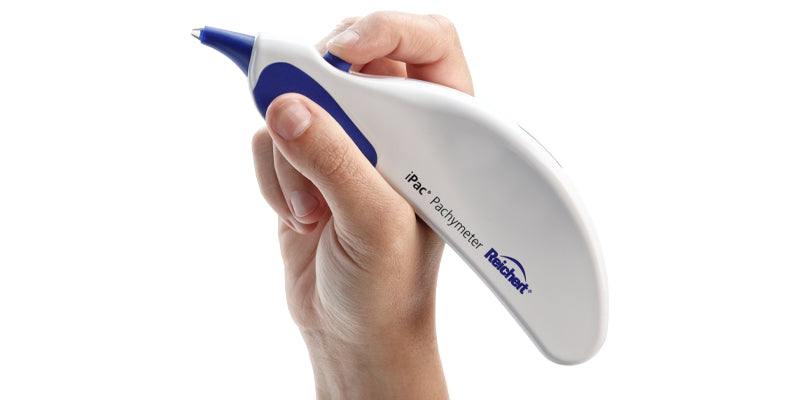
Reichert positions the iPac as its most feature-rich handheld ultrasound pachymeter. Everything runs from a single 5-way control button: press once to wake it, again to enter measurement mode, and toggle left or right to switch between OD and OS. The color LCD rotates automatically, so the reading stays legible however you approach the patient, and the body borrows its ergonomics from Reichert’s Tono-Pen AVIA tonometer, which many technicians already know. Reichert publishes a 200–1000 µm measurement range, ±5 µm accuracy, 1 µm resolution and a 10.5 MHz ultrasound frequency in a 100 g (3.53 oz) body measuring 179 x 37 x 56 mm. An advanced filtering algorithm is designed to keep central corneal thickness readings accurate across a wide range of corneal thicknesses. Power comes from a rechargeable lithium-ion battery charged with the supplied USB cable or an optional charging cradle, and Reichert lists its ReichertCapture EMR interface software among the iPac downloads. The iPac is designed and assembled in the USA. It is focused on fast CCT capture rather than corneal mapping or printing, which keeps the device simple but means documentation runs through software rather than an on-board printer.
Pros: Single 5-way button with quick OD/OS switching · Auto-rotating color LCD readable from any angle · Rechargeable lithium-ion battery with USB charging · Light 100 g body with Tono-Pen AVIA-style ergonomics · EMR interface software available from Reichert
Considerations: 1000 µm upper limit is lower than several units in this guide · No corneal mapping mode or built-in printer described on the product page
Best for: Busy optometry and glaucoma clinics that share one handheld across several exam lanes.
#3 · DGH Pachmate 2 (DGH 55B) (DGH Technology)
Best pocket handheld for peripheral mapping, with optional Bluetooth reporting.
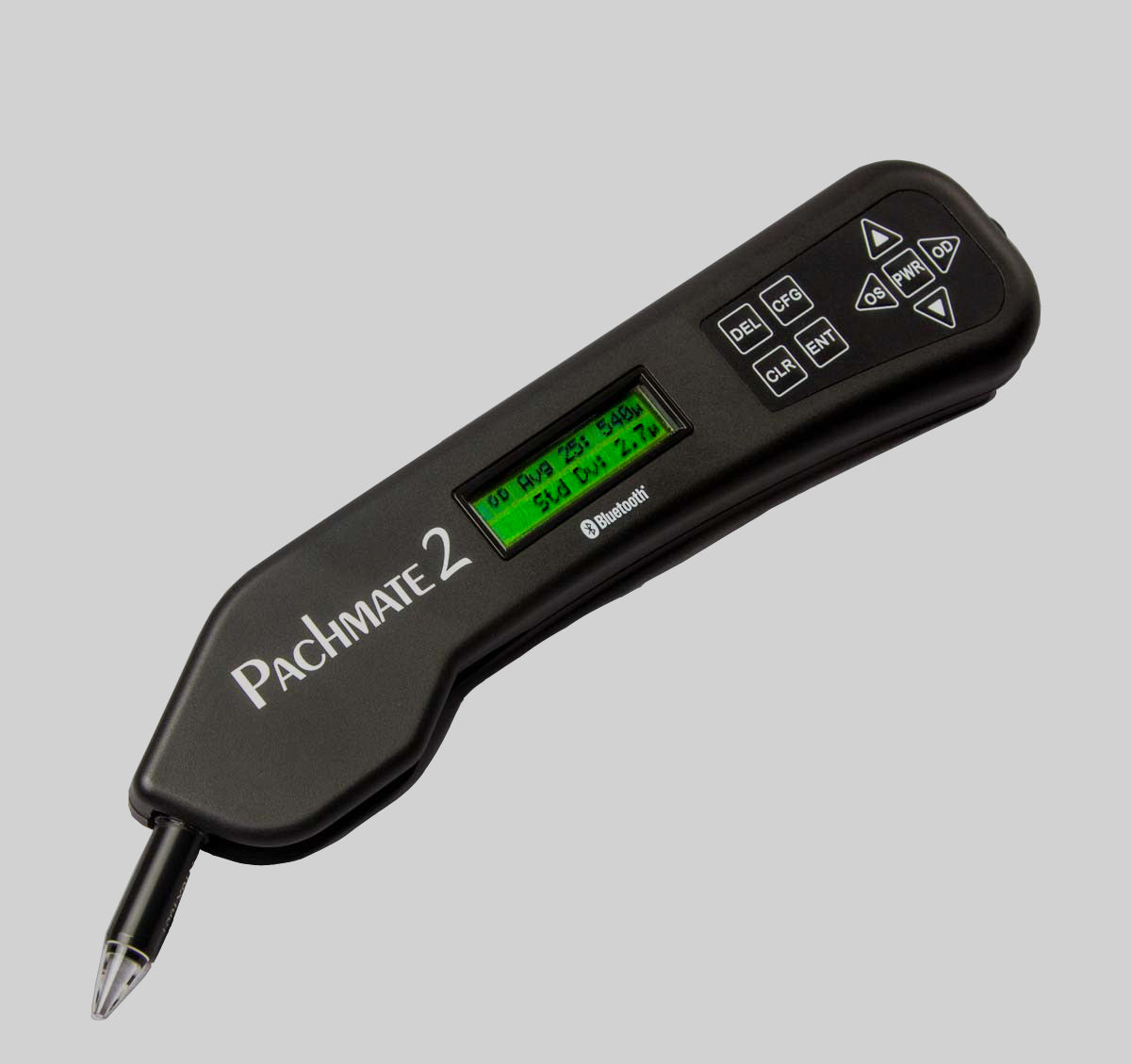
DGH Technology calls the Pachmate 2 (model DGH 55B) the global leader in handheld pachymetry, and its measurement algorithm builds on technology the company traces back to 1982. The workflow is deliberately simple: power on, touch the probe to the cornea, and the unit captures and stores up to 25 measurements in a fraction of a second, with an audible cue when a valid reading is complete. A 16-character, 2-line LCD shows the current measurement, the average and the standard deviation. The probe both rotates and detaches. It can be turned into the handpiece for protection when not in use or removed for cleaning or replacement, and spare probes let one go through disinfection while another stays in service. Mapping Mode stores up to 33 actual and biased measurements at any point on the cornea, including the periphery. DGH lists a 200–1100 µm range, ±5 µm accuracy and 1 µm resolution in a 112 g (3.6 oz) body powered by two AAA batteries. On the optional Bluetooth version, DGH Connect software sends patient IDs for up to 20 patients to the unit and returns results to a PC for reports or to a compatible Bluetooth printer.
Pros: Probe rotates into the handpiece for protection and detaches for cleaning · Mapping Mode records up to 33 central and peripheral points · Runs on standard AAA batteries or NiMH rechargeables · Ready to measure at power-up with no setup required · Optional Bluetooth reporting to a PC or printer
Considerations: Two-line text display is basic next to color screens · Wireless reporting requires the optional Bluetooth version · Probe frequency is not listed on DGH’s product page
Best for: Clinicians who need a pocketable pachymeter for multiple lanes, satellite offices or screening events.
#4 · DGH Pachette 4 (DGH 555B) (DGH Technology)
Best for surgical settings that need flap-range measurements and a sterilizable angled probe.
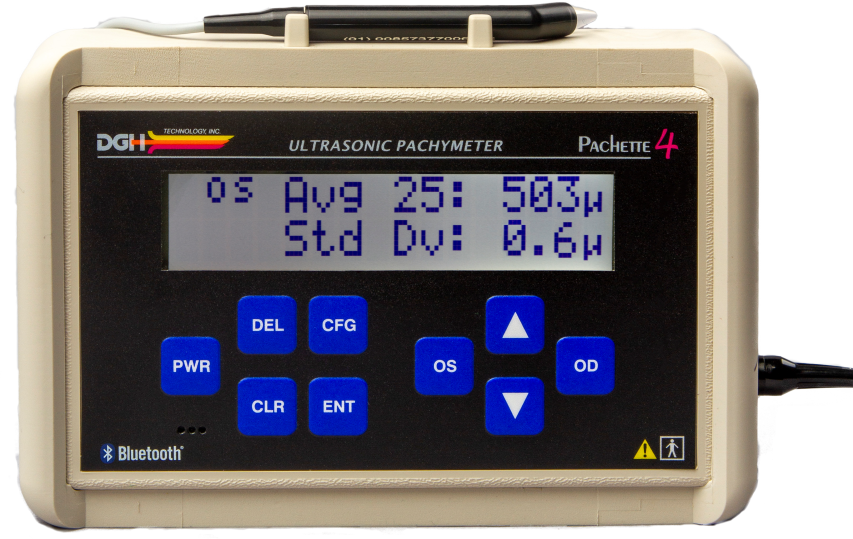
The Pachette 4 (DGH 555B) is DGH’s portable desktop pachymeter. It shares the Pachmate 2’s measurement approach and 16-character, 2-line display, storing up to 25 measurements with the average and standard deviation, but it lives in a durable rubber holster with a built-in tilt stand so it can sit on a counter or travel with the surgeon. Its angled probe detaches for cleaning and can be sterilized with a cold soak, which DGH says makes the Pachette 4 suited to intraoperative use, and a molded probe holder with a cord wrap protects the probe in transit. The standard range is 200–1100 µm, and an optional flap upgrade extends it to 95–1100 µm to help operators measure corneal thickness during corneal procedures. DGH lists ±5 µm accuracy and 1 µm resolution; the unit weighs 635 g (1.4 lb) and runs on two AA batteries. Mapping Mode stores up to 33 actual and biased measurements anywhere on the cornea, including the periphery, and the optional Bluetooth version works with DGH Connect for PC reports or direct thermal printouts on a compatible Bluetooth printer.
Pros: Optional flap range down to 95 µm · Detachable angled probe that can be cold-soak sterilized · Rubber holster with built-in tilt stand for counter or OR use · Mapping Mode with up to 33 points · Standard AA batteries
Considerations: Larger and heavier (635 g) than the handhelds in this guide · Extended flap range is an upgrade rather than standard · Two-line text display with no on-board printer
Best for: Refractive and cornea surgeons, ambulatory surgery centers and practices that measure in the OR as well as the clinic.

#5 · Accutome PachPen (Keeler (Accutome))
Best lightweight pen-style option with a built-in IOP correction calculator.
The PachPen comes from Accutome, now a Keeler-owned brand, and is offered in a standard version and a PachPen Vet version. At 85 g (3.0 oz) and roughly 7 1/4 by 1 1/4 inches, it is the lightest unit in this guide by the manufacturers’ published numbers. Keeler highlights a gentle 2.5 mm diameter probe tip intended for patient comfort and 65 MHz probe sampling, along with Accutome’s Digital Signal Analysis, which is designed to eliminate non-perpendicular measurements on the cornea. Published specifications are ±5 µm accuracy, ±1 µm resolution and a 300–999 µm measurement range. An IOP correction calculation converts IOP measurements based on corneal thickness in seconds, which suits glaucoma workups where you want the adjusted figure without a separate chart or app. Power comes from a 3.6 V lithium battery that Keeler rates at approximately 15,000 readings. Keeler’s pachymeter accessories include a test block for checking the device. The trade-off is scope: Keeler’s product page describes a CCT-focused pen and does not list corneal mapping, on-board memory details, printing or data export.
Pros: Lightest unit here at 85 g · Built-in IOP correction calculation · Small 2.5 mm probe tip · Digital Signal Analysis rejects non-perpendicular readings · Lithium battery rated for about 15,000 readings
Considerations: Narrowest stated range (300–999 µm), less suited to very thin corneas · No mapping, printing or data-export features described on the product page
Best for: Glaucoma-focused practices that want a quick CCT and IOP correction from a pen-size device.
#6 · PalmScan P2000FP FastPach (Micro Medical Devices)
Best for practices that want single-use probe tips and peripheral readings in a pen format.
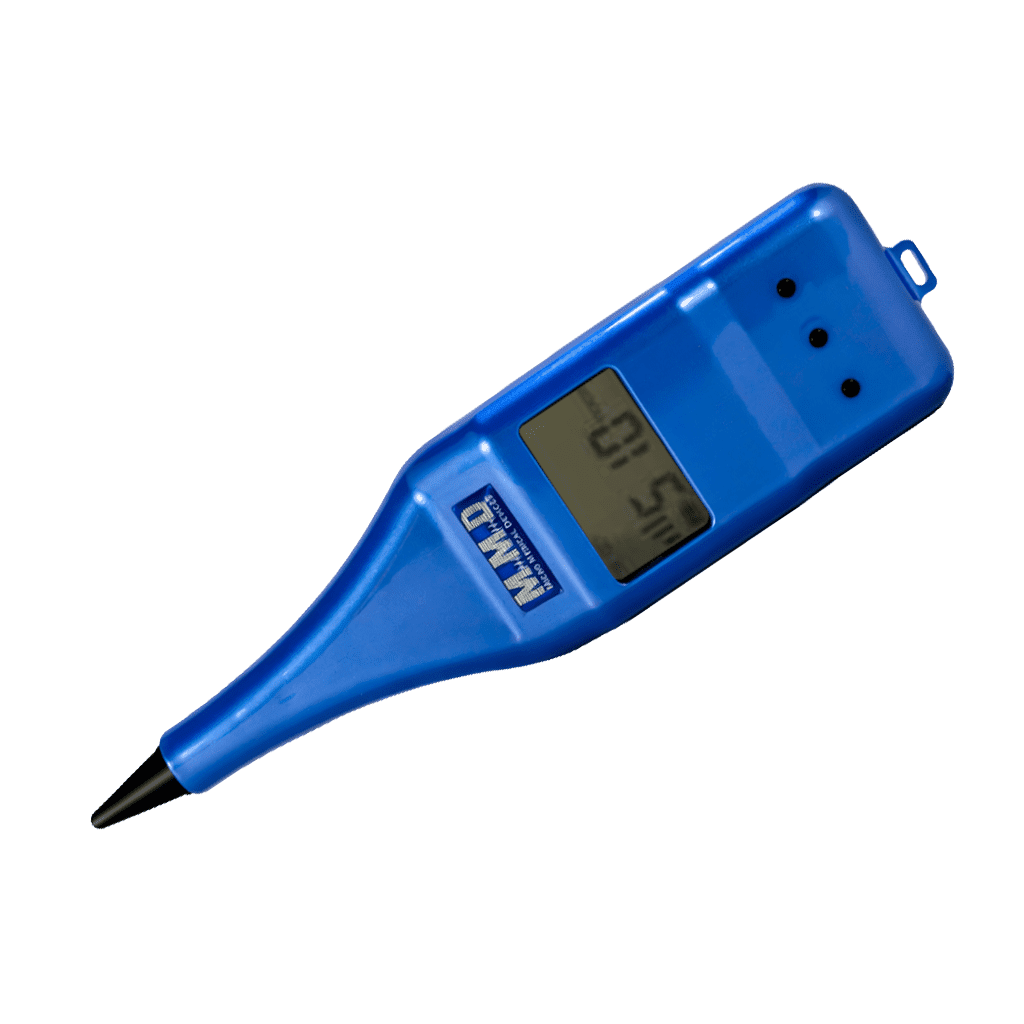
Micro Medical Devices (MMD), based in Calabasas, California, describes the P2000FP FastPach as a handheld pen pachymeter for central and peripheral corneal thickness measurements. MMD says its signal processing delivers a CCT reading in approximately one second, and a built-in Confidence Indicator helps the operator verify measurement quality on every reading. A one-touch interface keeps operation straightforward for technicians in fast-moving clinics. The company quotes what it calls an industry-leading 264 MHz sampling frequency with a 50 MHz probe. The pen is compatible with MMD’s proprietary single-use Pachy Tips, which simplify cleaning between patients and lower the risk of damaging the probe, a practical advantage for high-volume screening. MMD offers a 30-day trial with no deposit or commitment fee, so a practice can try it on its own patients and staff before deciding. The FastPach product page does not publish a measurement range, accuracy figure, weight or power details for the pen itself, so request the full specification sheet before comparing it line by line with the other units in this guide.
Pros: Single-use Pachy Tips simplify cleaning and protect the probe · Reading in about one second with a Confidence Indicator · Central and peripheral measurements · 50 MHz probe with 264 MHz sampling · 30-day trial with no deposit
Considerations: Range, accuracy, weight and power are not published on the FastPach product page · Single-use tips add a recurring consumable cost · No printing or reporting details listed for the pen
Best for: High-volume practices that prioritize infection control and quick screening CCTs.
Feature comparison
| Model | Format | Display / controls | Measurement range | Stated accuracy | Probe | Mapping | Weight | Power | Data output |
|---|---|---|---|---|---|---|---|---|---|
| Ezer EUS-1800 P | Portable console | Color LCD touch screen | 230–1200 µm | ≤ ±5 µm | 20 MHz, straight or angled | Corneal thickness distribution maps | — | AC adapter (listed accessory) | Built-in thermal printer; 180 patient records; PC connection |
| Reichert iPac | Handheld | Auto-rotating color LCD; 5-way button | 200–1000 µm | ±5 µm | 10.5 MHz | — | 100 g | Rechargeable lithium-ion (USB) | ReichertCapture EMR interface software |
| DGH Pachmate 2 (55B) | Handheld | 16-character x 2-line LCD | 200–1100 µm | ±5 µm | Detachable, retractable | Up to 33 mapped points | 112 g | 2 AAA batteries | Optional Bluetooth to PC or printer |
| DGH Pachette 4 (555B) | Portable desktop | 16-character x 2-line LCD | 200–1100 µm (95–1100 µm flap option) | ±5 µm | Detachable angled, cold-soak sterilizable | Up to 33 mapped points | 635 g | 2 AA batteries | Optional Bluetooth to PC or printer |
| Accutome PachPen | Handheld pen | — | 300–999 µm | ±5 µm | 2.5 mm tip; 65 MHz sampling | — | 85 g | 3.6 V lithium battery | — |
| MMD PalmScan P2000FP FastPach | Handheld pen | One-touch interface | — | — | 50 MHz probe; 264 MHz sampling; single-use tips | Central and peripheral readings | — | — | — |
Why it’s our top pick
US Ophthalmic manufactures the Ezer line, so when you buy an EUS-1800 P you deal with one US team for the quote, the delivery, technical support, repairs and spare parts. New Ezer equipment comes with a US warranty, and our in-house technical and spare-parts departments mean a probe question or service need does not have to be routed through a third party. Pricing is quote-based, so you can request a quote that matches your configuration, including the straight or angled probe.
The competitors in this guide are respected, well-established instruments, and each has a clear niche: the iPac and PachPen for pen-style speed, the Pachmate 2 for pocket portability, the Pachette 4 for surgical flap measurements and the FastPach for single-use tips. Where the EUS-1800 P stands out is in combining a color touch screen, corneal thickness maps, user-defined IOP parameters, a built-in printer and patient memory in one unit, backed by the company that builds it.
Ready to spec your ultrasounds?
Send us your requirements and our equipment specialists will come back with a configuration built around how your practice actually works — including availability and lead time. US Ophthalmic is a direct provider to eye care practices nationwide.
Frequently asked questions
What does a pachymeter measure, and why do eye care practices need one? A pachymeter measures corneal thickness, most commonly central corneal thickness (CCT). Practices use it to interpret applanation IOP readings in glaucoma workups, to screen candidates for refractive surgery, to follow corneas with suspected ectasia such as keratoconus and to plan procedures like limbal relaxing incisions. Ultrasound pachymeters do this with a small contact probe and report results in microns (µm).
Is an ultrasound pachymeter better than optical pachymetry? Neither is universally better. Ultrasound pachymeters are compact, quick and dedicated to the task, and handheld models move easily between rooms. Optical methods, such as those built into OCT or Scheimpflug systems, are non-contact but come as part of larger imaging platforms. Because different methods can read differently, it is good practice to follow an individual patient over time with the same type of instrument.
How does corneal thickness relate to IOP readings? Goldmann applanation tonometry is calibrated around an average corneal thickness, so a thicker or thinner cornea can make the measured IOP read higher or lower than the true pressure. That is why many pachymeters include IOP correction tools: the Ezer EUS-1800 P lets you define IOP parameters, and the Accutome PachPen has a built-in IOP correction calculation. Correction formulas vary and are a reference for the clinician, not a substitute for clinical judgment.
What measurement range should my pachymeter cover? Typical corneas fall comfortably inside every range in this guide. Range becomes important at the extremes: very thin post-refractive or intraoperative corneas call for a low floor (the DGH Pachette 4 flap option measures down to 95 µm), while swollen corneas call for a high ceiling (the Ezer EUS-1800 P lists up to 1200 µm). Check the published range against the patients you actually see.
Should I buy a handheld pachymeter or a console unit? Choose a handheld or pen model if one device has to serve several lanes, satellite offices or screenings. Choose a console or desktop unit if you want a larger screen, mapping display, on-board printer or a stand that keeps the device in one place, as with the Ezer EUS-1800 P or DGH Pachette 4.
How should an ultrasound pachymeter probe be cleaned and checked? Always follow the manufacturer’s instructions for use. Designs differ: DGH probes detach for cleaning, the Pachette 4 probe can be cold-soak sterilized, and MMD’s FastPach uses single-use tips. Most manufacturers also provide a way to verify performance; the EUS-1800 P ships with a test object, and Keeler offers a pachymeter test block as an accessory.
How do I get pricing on the Ezer EUS-1800 P? US Ophthalmic prices equipment by quote. Request a quote on the EUS-1800 P product page or call the team, and we will confirm the configuration, availability and what is included, along with the US warranty and access to our in-house technical and spare-parts departments.
The verdict
For most practices the Ezer EUS-1800 P is the strongest all-round ultrasound pachymeter in 2026: it combines a 20 MHz straight or angled probe, a color touch screen, corneal thickness maps, user-defined IOP parameters, a built-in printer and patient memory, and it is backed by US Ophthalmic’s in-house service and parts. It suits practices that want one pachymetry station for glaucoma, refractive and cornea work.
If portability is the priority, the Reichert iPac and DGH Pachmate 2 are excellent handhelds, and the Accutome PachPen is the lightest choice with built-in IOP correction. Surgeons who measure flaps or work in the OR should look closely at the DGH Pachette 4, and practices focused on single-use tips can trial the MMD FastPach. Whichever direction you lean, request a quote on the EUS-1800 P to compare it side by side.