
















Best Ophthalmic Exam Chairs in 2026
The Ezer ERU-2600 is our top ophthalmic exam chair for 2026: 170-degree motorized recline, auto return and US service. Compare 6 chairs side by side.
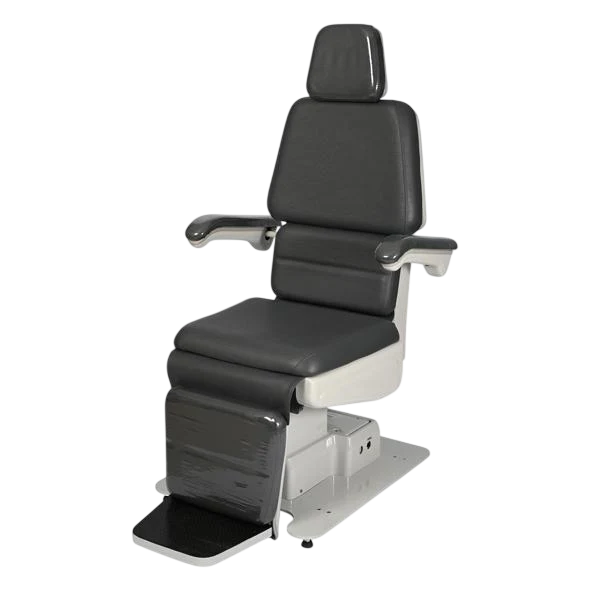
Our top pick for 2026 is the Ezer ERU-2600 Chair. It is a fully motorized exam chair that raises the seat and reclines the back and leg rest on quiet, oil-free electric gear motors, reclines up to 170 degrees, and returns the patient upright with a single "Back-to-Zero" touch. It is built by Ezer, US Ophthalmic's own house brand, so parts, repairs and technical support come from the same team that supplies the chair.
This guide covers standalone motorized and power-assisted patient exam chairs only. If you are equipping a full lane with a chair and instrument stand as one package, see our refraction unit options, and for surgical stretchers and stools see the dedicated guides. Here we compare six chairs that show up in most practice build-outs: the Ezer ERU-2600, the Reliance 7000 and Reliance 6200 from Haag-Streit, the Topcon OC-2300, the Marco Encore Automatic and the S4OPTIK 2500-CH.
Every specification below comes from the manufacturer's own product page or data sheet. Where a maker does not publish a figure, we left it blank rather than guess. Pricing is quote-based across this category, so we focus on what actually changes your day: recline range, lift range, controls, patient access and who services the chair when a motor fails on a Monday morning.
Shopping for chairs? US Ophthalmic is a direct provider of chairs to eye care practices across the US. Tell us how your lane is set up and we will come back with the configurations that fit, plus current availability and lead times.
How to choose an ophthalmic exam chair
- Recline drive and range: Fully motorized recline lets you move a patient from seated to supine with one hand while the other stays on the slit lamp or BIO. Manual or pneumatic-assisted recline is simpler but asks more of the operator. Check the maximum angle: a near-flat or 170-degree recline matters if you do minor procedures, punctal plugs or indirect ophthalmoscopy on reclined patients.
- Seat height range: The low seat height decides how easily elderly and short patients get on, and the high end decides whether a tall clinician can work standing. Compare the published lowest and highest seat heights against your instrument stand and slit lamp table, and remember that some makers offer high and low base versions.
- Controls and workflow: Look for switches on both sides of the chair, a foot switch, an auto-return or memory position, and a lockout that stops children from moving the chair. These small details save seconds on every patient and add up across a full clinic day.
- Patient access and safety: Armrests that lock and release to either side, a footrest that supports full patient weight, and a stable base all reduce transfer risk. If you see many wheelchair users, ask whether the chair accepts a mover or glide, or whether a separate wheelchair-accessible setup is the better fit.
- Headrest: An articulating, height-adjustable headrest that locks with one hand helps you position patients for the slit lamp, retinal imaging and procedures. Check which headrests ship standard and which are optional surgical upgrades.
- Capacity, power and build: Compare published patient or base capacity, voltage (useful if you also operate outside the US), unit weight for floor loading and moving, and frame materials. Easy-to-clean upholstery with rounded edges is worth a lot in a high-turnover lane.
- Service and parts: A chair is a motorized, load-bearing device that will need service. Ask who stocks motors, switches and upholstery, and who answers the phone when the lift stops working, before you compare anything else.
#1 · Ezer ERU-2600 Motorized Exam Chair (Ezer)
Best overall: full motorized positioning with a 170-degree recline and one-touch return, backed by in-house US parts and service.
The ERU-2600 is a fully motorized chair: the seat lift, backrest and leg rest are all driven by quiet, oil-free electric gear motors, so you can move a patient from upright to fully reclined, or stop anywhere in between, from the touch control panel. The recline reaches up to 170 degrees and the chair measures 77 in (1950 mm) long when reclined, which gives you real room for procedures and examinations on a reclined patient. Seat height runs from 21 in (510 mm) to 28 in (710 mm), a friendly range for elderly patients getting on and off. A single-touch Back-to-Zero button returns the patient upright, the footrest deploys automatically as the chair reclines, and the armrests lock and release so patients can exit from either side. The padded headrest articulates and adjusts for height. Build quality is solid: an SAE 1020 carbon steel frame with epoxy paint, a polystyrene finish that wipes clean, injected foam with an anti-deformation system, and curved upholstery with an anti-mold coating. It runs on 110 or 220 V with manual selection and weighs 171.6 lb. Because Ezer is US Ophthalmic's own brand, spare parts such as motors and foot switches and repair work come from the same in-house team.
Pros: Motorized seat, backrest and leg rest on oil-free gear motors · Recline up to 170 degrees, 77 in reclined length · One-touch Back-to-Zero auto return · Armrests lock and release to either side · Articulated, height-adjustable headrest · 110/220 V manual voltage selection · In-house US parts and technical support
Considerations: Manufacturer does not publish a patient weight capacity on the product page · Seat height tops out at 28 in, lower than high-base chairs for standing clinicians · No programmable memory positions listed beyond auto return
Best for: Optometry and ophthalmology practices that want a fully motorized chair with deep recline and a single supplier for parts and service.
View the Ezer ERU-2600 Motorized Exam Chair & request a quote →

#2 · Reliance 7000 Procedure Chair (Haag-Streit (Reliance))
Best for minor procedures: a power base and top that reclines nearly flat, with a heavily tested hydraulic base.
The Reliance 7000, now sold under Haag-Streit, is positioned as a dual-purpose exam chair and minor procedure table. It has a power hydraulic base and a powered top, operated by finger switches on both sides or a corded foot switch, and it reclines to a nearly flat position. Haag-Streit states the hydraulic base is tested to 600 pounds. A memory positioning switch stores your most-used position, and a safety switch disables the side and foot switches so children cannot move the chair. The product sheet lists two base heights: the high base goes from 22.75 in lowered to 33.4 in raised, and the low base from 20.25 in to 28.75 in. Dual rotation locks allow 330 degrees of swivel, armrests lock and release on both sides, and the large hinged footrest supports a patient's full weight. The standard No. 18 concave headrest is fully adjustable for diagnostic work, with pillow and articulating surgical headrests optional. Upholstery is hand-sewn over high-density foam with removable cushions. The product sheet notes the 7000 is made in the USA and lists 115 V standard with a 230 V option. It is a heavy, substantial chair, with a listed shipping weight of 325 lb.
Pros: Power base and top, reclines nearly flat · Hydraulic base tested to 600 pounds · Memory position and child safety lockout · High and low base options · Wide headrest choice including surgical
Considerations: Large footprint and 325 lb shipping weight · Surgical headrests are optional extras · Service runs through Haag-Streit's network rather than a single local team
Best for: Ophthalmology practices that perform minor procedures in the exam lane and want a chair that doubles as a procedure table.

#3 · Topcon OC-2300 Ophthalmic Chair (Topcon)
Best for tall clinicians: powered recline, two memory positions and a high-lift option up to 35 in seat height.
The OC-2300 is the fully powered recline model in Topcon's chair line, sitting above the manual-recline OC-2200. It combines a motorized recline with a hydraulic lift, and Topcon offers two lift versions: a low lift with a 9 in stroke and a maximum seat height of 29 in, or a high lift with a 12.5 in stroke and a maximum seat height of 35 in. That high-lift option is useful when clinicians examine standing or share the lane with tall colleagues. Two user-programmable memory positions let you jump between your most common working positions, and illuminated membrane switches sit on both sides of the chair. The frame, armrests, footrest and base are solid cast aluminum, the armrests fold with a single button, and the headrest articulates with one hand. A locking hand brake with handles on both sides holds the chair in rotation, and Topcon's data sheet lists 355 degrees of rotation and a chair capacity of 500 lb. Power options are 115 V or 220 V, and the chair is ETL listed to UL and CSA standards. Topcon offers a broad choice of upholstery colors.
Pros: Motorized recline with two programmable memory positions · High-lift option to 35 in seat height · 500 lb chair capacity per Topcon data sheet · Cast aluminum frame and base · Switches on both sides, locking rotation brake
Considerations: Lift is hydraulic, recline is motorized: two systems to maintain · Maximum recline angle not published · Low-lift version tops out at 29 in seat height
Best for: Lanes built around Topcon instruments, and practices with clinicians who prefer to work standing.

#4 · Marco Encore Automatic Exam Chair (Marco)
Best for programmable workflow: auto hydraulic recline with programmable recline positions and a safety lockout.
The Encore Automatic is Marco's powered-recline chair, built on the same basic design as the Encore Manual. Recline uses Marco's dual hydraulic system with a sealed, fail-safe design, and both elevation and recline are one-button operations from fully upright to horizontal. Backlit fingertip switches on either side control elevation, recline and auto-return, and a corded foot switch duplicates those functions. Recline positions are programmable with a finger-controlled dial, and a safety function disables the switch panel. The headrest operates with one hand and shows a safety lock indicator, and an optional pillow headrest and surgical package, including a fixed surgical headrest and surgeon's hand rest, adapts the chair for minor procedures. A rear-mounted, foot-activated rotation lock is reachable from both sides, with 270 degrees of rotation. Marco lists a lift capacity of approximately 330 lb, a 120 VAC, 60 Hz supply and a net weight of 254 lb. Scuff-resistant covers protect the arms and base, and an optional chair mover or glide helps when you need to make room for wheelchair patients.
Pros: Auto hydraulic recline to horizontal · Programmable recline positions and auto-return · Switch panel safety lockout · Optional surgical package · Compatible with an optional chair mover or glide
Considerations: Approximately 330 lb lift capacity, lower than several rivals · 120 VAC only per the spec table · 270 degrees of rotation, less than some competitors
Best for: Practices with Marco lanes that want programmable recline positions and an easy path to wheelchair access.

#5 · S4OPTIK 2500-CH Examination Chair (S4OPTIK)
Best for flexible height control: motorized recline to supine with lift control from the slit lamp arm, stand or foot switch.
The 2500-CH is S4OPTIK's fully automatic exam chair. It reclines from seated to supine, or any position in between, with recline, return and stop on membrane buttons on both sides of the chair. Lift is driven by a Swiss-designed linear actuator that S4OPTIK describes as smooth and virtually silent, and the chair is rated for 500 lb. Seat height runs from 21.5 in up to 33.3 in, one of the wider ranges in this guide. A practical touch is where you control height from: the slit lamp arm, the stand console when paired with an S4OPTIK instrument stand, or a movable foot switch. The upholstered armrests retract individually, the broad footrest retracts when not needed and is rated to hold the patient's full weight, and the headrest positions with one hand and a non-slip lock. A foot-actuated rotation lock is accessible from both sides. S4OPTIK does not publish power requirements, dimensions or unit weight on the product page, and at the time of writing the product page showed it as out of stock, so confirm lead time before you plan an opening date.
Pros: Motorized recline from seated to supine · 500 lb capacity on a linear actuator lift · Wide 21.5 to 33.3 in seat height range · Height control from slit lamp arm, stand or foot switch · Individually retracting armrests
Considerations: Power, dimensions and weight not published on the product page · Product page showed out of stock at time of writing · Best integration requires S4OPTIK stands
Best for: Practices pairing the chair with an S4OPTIK stand that want height control at the slit lamp.

#6 · Reliance 6200 Exam Chair (Haag-Streit (Reliance))
Best simpler option: power hydraulic lift with a manual pneumatic-assisted recline.
The Reliance 6200 is the classic workhorse configuration many optometry lanes were built around: a power hydraulic base for elevation, paired with a manual, pneumatic-assisted recline that takes the chair to a table position. That split suits practices that mainly need fast height adjustment at the slit lamp and refractor and only occasionally recline a patient. Haag-Streit designed it for efficient operation from both sides of the chair, and it ships with the No. 18 concave, fully adjustable headrest, which is used primarily as a diagnostic headrest in ophthalmic practice, with other headrests available. Compared with the fully powered chairs above, there are fewer motors to service, but the operator does the reclining, which takes a free hand and some effort with larger patients. Haag-Streit's 6200 page does not list capacity, seat height range or electrical specifications, so request the current data sheet before you plan room layout. If most of your exams are upright refraction and anterior segment work, this simpler mechanism may be all you need; if you recline often or do procedures, a fully motorized chair such as the ERU-2600 or Reliance 7000 is the better match.
Pros: Power hydraulic lift · Pneumatic-assisted recline to table position · Operable from both sides · Fully adjustable concave diagnostic headrest standard
Considerations: Recline is manual, not motorized · No capacity, height range or electrical specs on the product page · Less suited to frequent reclined exams or procedures
Best for: Refraction-focused optometry lanes that rarely recline patients.
Feature comparison
| Model | Recline | Max recline | Lift | Seat height (low to high) | Capacity | Rotation | Memory / auto return | Power | Unit weight |
|---|---|---|---|---|---|---|---|---|---|
| Ezer ERU-2600 | Motorized (electric gear motors) | Up to 170° | Motorized | 21 to 28 in | — | — | Auto return (Back-to-Zero) | 110/220 V, manual selection | 171.6 lb |
| Reliance 7000 | Power | Nearly flat | Power hydraulic | High base 22.75 to 33.4 in; low base 20.25 to 28.75 in | Base tested to 600 lb | 330° | Memory position | 115 V (230 V optional) | 325 lb shipping |
| Topcon OC-2300 | Motorized | — | Hydraulic, 9 in or 12.5 in stroke | Max 29 in (low lift) or 35 in (high lift) | 500 lb | 355° | 2 programmable memories | 115 V or 220 V | 286 lb shipping |
| Marco Encore Automatic | Auto hydraulic | Horizontal | Hydraulic | — | Approx. 330 lb lift capacity | 270° | Programmable recline, auto return | 120 VAC, 60 Hz | 254 lb net |
| S4OPTIK 2500-CH | Motorized | Supine | Linear actuator | 21.5 to 33.3 in | 500 lb | — | — | — | — |
| Reliance 6200 | Manual pneumatic-assisted | Table position | Power hydraulic | — | — | — | — | — | — |
Why it’s our top pick
Exam chairs are mechanical, motorized and used on every patient, so the real cost of ownership shows up when a motor, switch or foot pedal needs attention. The Ezer ERU-2600 is built under US Ophthalmic's own house brand, and US Ophthalmic runs an in-house technical and repair department and a spare-parts department, so the team that supplies the chair also stocks its parts and services it. New equipment ships with a US warranty.
If you are planning a full lane rather than replacing a chair, our team can also quote the Visionare refraction units in our refraction units collection, which pair a chair with an instrument stand. All pricing is by quote, and financing is available on request.
Ready to spec your chairs?
Send us your requirements and our equipment specialists will come back with a configuration built around how your practice actually works — including availability and lead time. US Ophthalmic is a direct provider to eye care practices nationwide.
Frequently asked questions
What is the best ophthalmic exam chair in 2026? For most practices we recommend the Ezer ERU-2600. It is fully motorized, reclines up to 170 degrees, returns the patient upright with one touch and is supported by US Ophthalmic's in-house parts and service team. The Reliance 7000 is a strong choice for procedure-heavy ophthalmology lanes, and the Topcon OC-2300 high-lift version suits clinicians who work standing.
Do I need a fully motorized exam chair, or is manual recline enough? If you mostly refract and do upright slit lamp exams, a power lift with manual recline, such as the Reliance 6200, can be enough. If you recline patients often for BIO, imaging or minor procedures, a motorized recline saves effort and keeps one hand free for the patient or instrument.
What seat height range should an ophthalmic exam chair have? A low seat height around 20 to 21 in makes it easier for elderly patients to get on. The high end matters for standing clinicians: published maximums in this guide range from 28 in on the ERU-2600 to 35 in on the Topcon OC-2300 high-lift version. Match the range to your instrument stand and the heights of your clinicians.
What is the difference between an exam chair and a refraction unit? An exam chair is the patient chair on its own. A refraction unit pairs a chair with an instrument stand that carries the refractor arm, slit lamp arm, lights and controls. This guide covers standalone chairs; refraction units and stands are covered separately.
Can wheelchair patients be examined in these chairs? Patients who can transfer benefit from armrests that release to either side, which the ERU-2600 and Reliance 7000 offer. Marco offers an optional chair mover or glide for the Encore Automatic to make room for a wheelchair. If you examine many non-transferring patients, plan a dedicated wheelchair-accessible setup.
How much does an ophthalmic exam chair cost? Pricing in this category is quote-based and depends on configuration, upholstery, headrests and whether you buy a chair alone or a full lane. Request a quote from US Ophthalmic for the ERU-2600, and ask about financing at the same time.
The verdict
The Ezer ERU-2600 is our top ophthalmic exam chair for 2026. It covers the features that matter in daily use, fully motorized positioning, a 170-degree recline, an articulating headrest and one-touch auto return, and it comes with parts and service from US Ophthalmic's own team.
Choose the Reliance 7000 if your lane doubles as a minor procedure room, the Topcon OC-2300 high-lift version if your clinicians work standing, the Marco Encore Automatic for programmable recline positions in a Marco lane, the S4OPTIK 2500-CH if you want lift control at the slit lamp arm, and the Reliance 6200 if you rarely recline patients and want a simpler mechanism.