
















Prism Bar vs Loose Prism Set: Choosing Prism Tools for the Exam Lane
Prism bar vs loose prism set: range, step size, speed, acrylic vs glass holding position, stacking, the Maddox rod and what to check on arrival.
A prism bar and a boxed loose prism set measure the same thing — a deviation in prism diopters (Δ) — but they suit different lanes, different patients and different paces of work. A practice that buys the wrong one ends up either fumbling single prisms during a quick cover test or reaching for a bar that cannot go high enough or fine enough. This guide compares the two formats, where the phoropter’s own rotary prisms fit, what the Maddox rod adds, and what to check when the box arrives.
It is written for the people who equip the lane — ODs, practice owners, binocular-vision and pediatric clinics, and clinic buyers. It covers workflow and purchasing, not clinical interpretation.
Shopping for Browse diagnostic aids? US Ophthalmic is a direct provider of Browse diagnostic aids to eye care practices across the US. Tell us how your lane is set up and we will come back with the configurations that fit, plus current availability and lead times.
The short answer
- Buy a prism bar set (horizontal + vertical) when speed matters: routine cover-test neutralization, vergence ranges, screenings, and children with short attention spans. One bar slides through many powers without putting anything down.
- Buy a loose prism set when range and granularity matter: large angles, half-diopter steps, splitting prism between the eyes, or combining a horizontal and a vertical measurement with separate pieces.
- Most full-scope lanes keep both. They do not replace each other. The phoropter’s Risley prisms are a third tool, not a substitute for either.
What each format is
Prism bars
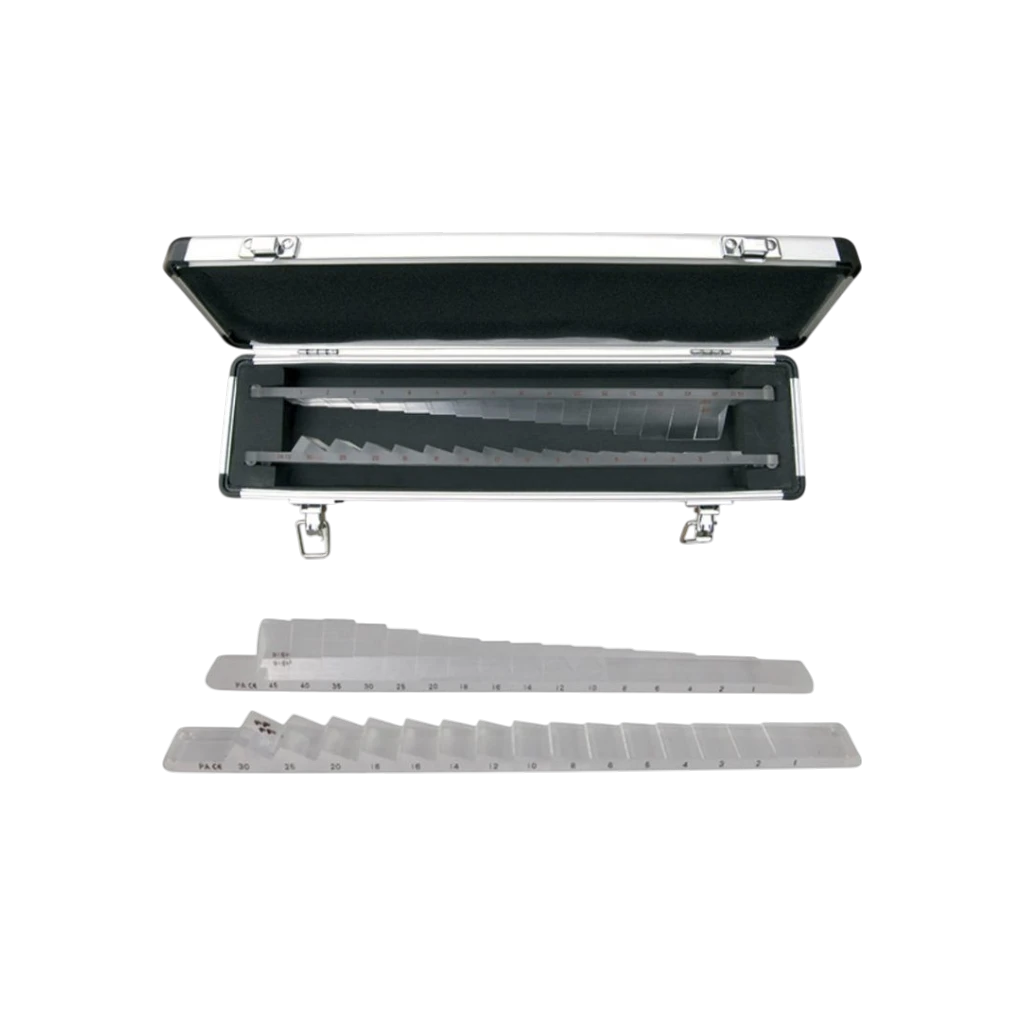
A prism bar is a strip of molded prisms of increasing power in one piece. Good-Lite’s clinical prism guide describes bars as arranging “sequential step increments on a single bar, making them the standard instrument for vergence range testing and rapid cover test neutralization,” and notes that “their speed and convenience make them especially practical in clinical screening settings.” The same guide gives the bar range as 1Δ–40Δ and notes that bars “advance in larger 1–5Δ steps.”
Bars come in two orientations: a horizontal bar (base-in / base-out measurements) and a vertical bar (base-up / base-down), usually shorter in range. Published step sequences show the pattern:
| Bar (published listing) | Steps listed | What to notice |
|---|---|---|
| Gulden vertical bar (McKesson listing, clear acrylic, 15 segments) | 1, 2, 3, 4, 5, 6, 8, 10, 12, 14, 16, 18, 20, 25, 30Δ | 1Δ steps at the low end, then 2Δ, then 5Δ above 20Δ |
| Amcon horizontal bar | “from 1 to 40,” plus a loose 45Δ prism | Higher top end than a vertical bar; one maker adds a loose piece to extend it |
The practical reading: the step sequence printed on the bar is the resolution you work at. If your lane routinely needs values between the printed steps, a bar alone will not give them.
Loose prism sets (prism boxes)
A loose set is a case of individual prisms, each a single power. Good-Lite gives loose prisms the widest range of the clinical forms — “1Δ–60Δ” — and describes them as the go-to tool for precise measurement, cover testing and neutralization. Piece counts and the powers included vary by set; one published 16-piece set, for example, runs from ½Δ to 50Δ plus a red lens. Read the power list, not just the piece count, before you compare two boxes.
The phoropter’s rotary (Risley) prisms
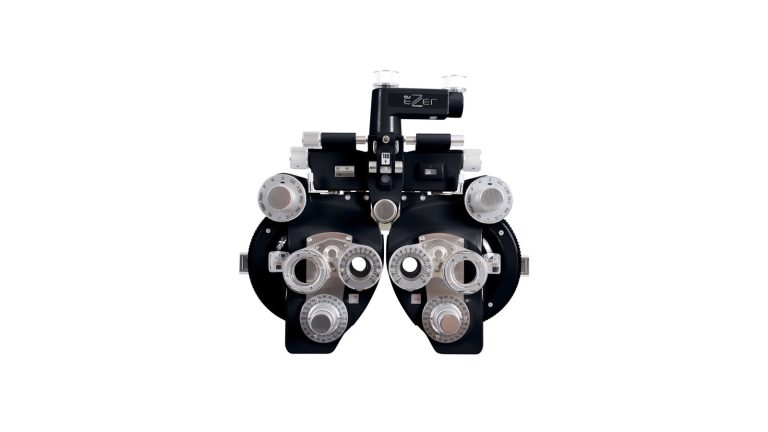
The rotary prisms on a refractor head change power continuously by turning a knob. Good-Lite contrasts them directly with bars: Risley prisms “deliver gradual 1Δ step increments through smooth rotation, while prism bars advance in larger 1–5Δ steps,” and the guide states the two are “not clinically interchangeable” for vergence testing because the step size changes the values recorded. In practice that means a lane should record which tool produced a number, and use the same tool when comparing visits. For operating the rotary prisms themselves, see Step 7 of our how to use a phoropter guide — they only work with the head in front of the patient, which is exactly the situation where a hand-held bar or loose prism is not needed, and vice versa.
Head-to-head: bar vs loose set
| Buying factor | Prism bar set | Loose prism set |
|---|---|---|
| Speed in a cover test | Fastest — slide to the next segment one-handed | Slower — swap pieces between steps |
| Range (Good-Lite figures) | 1Δ–40Δ | 1Δ–60Δ |
| Step size | Fixed by the bar, 1–5Δ | Whatever powers are in the box, some sets down to ½Δ |
| Splitting prism between eyes | Possible with two bars | Easy — one piece per eye |
| Pediatric and mobile use | Strong — few parts, quick, one object to keep track of | Weaker — small pieces to lose in transit |
| Holding position | Acrylic — frontal plane | Depends on material — check the set |
Material decides how the prism must be held
This is the buying detail most often missed, and it applies to both formats. Prisms are calibrated for a specific holding position:
- Glass prisms were classically calibrated for the Prentice position; plastic prisms for the frontal position (Wikipedia, citing Elkington’s Clinical Optics).
- Good-Lite puts the cost of getting it wrong in numbers: a 40Δ glass prism held in the frontal plane instead of the Prentice position “yields only 32Δ of effect,” and a 40Δ plastic prism held in the Prentice position “produces a staggering 72Δ.”
So before a set goes into the lane, confirm its material and post the matching holding position where staff can see it. If the practice owns both glass and acrylic prisms, keep them in separate, labeled cases. Mixed sets are an avoidable source of disagreement between examiners.
Stacking prisms is not simple addition
When a deviation exceeds the largest single piece, examiners sometimes stack two prisms. A study summarized by Eye News found the measured result differs from “the sum of the labelled prisms; an additivity error, which increased exponentially with increase prism strength,” and the authors built a look-up table for combined values. Wikipedia’s prism cover test entry adds a practical workaround: with larger deviations “it may be easier to place one before each eye.”
The purchasing takeaway: if your patient mix includes large angles, a loose set with high single-piece powers (and a second set or a bar for the other eye) saves you from stacking at all. A bar set alone tops out at the end of the bar.
Whichever you use, the prism has to be square to the line of sight. Wikipedia’s entry is blunt about it: “if they are held off centre the power of the prism will not be accurate.”
Where the Maddox rod fits
The Maddox rod is a companion accessory, not a prism. Wikipedia describes it as “a handheld instrument composed of red parallel plano convex cylinder lens, which refracts light rays so that a point source of light is seen as a line or streak of light.” In use it presents “a red line image to one eye and a white light to the other,” and prisms are added until the line and the light line up — which is why it is normally used together with a prism bar or loose prisms. The trial-lens tray in many sets also carries one; our trial lens set and trial frame guide lists it among the accessories to confirm in the tray. We do not currently list a standalone Maddox rod, so check your trial set or ask us when you request a quote.
Which lane needs which
General optometry lane
A horizontal + vertical bar set covers the everyday cover test and vergence ranges quickly; the phoropter’s rotary prisms cover the in-the-head work. Add a loose set if the practice sees binocular-vision referrals or larger angles.
Pediatric and binocular-vision clinics
Both. The bar for speed with a short attention span, the loose set for range and for splitting prism between the eyes.
Screenings, mobile and outreach
The bar set. Fewer loose parts to lose between sites, one case, and no refractor head required. Our Snellen chart and distance lane setup guide covers the distance target side of the same workflow.
The prism tools we supply
US Ophthalmic carries Luxvision prism sets in our prism and binocular-testing accessories category:
- Luxvision PR-1000 Prism Bar Set — a horizontal and a vertical prism bar in quality acrylic, supplied in an aluminum case. Acrylic means frontal-plane holding.
- Luxvision PB-2400 Prism Box — a 23-piece loose prism set in an aluminum case; the product page describes the prisms as calibrated.
- Luxvision PB-1700 Prism Box — a 17-piece loose prism set in an aluminum case, also described as calibrated.
Our product pages do not list the individual power steps for these sets. Ask for the power list with your quote and compare it against the range your lane actually uses before ordering — that is the comparison that matters, not the piece count.
What to check on arrival
- Power list against the packing slip. Every piece or segment present, every marking legible.
- Material and holding position. Confirm glass or acrylic and label the case with the matching position.
- Surface condition. No scratches, chips or crazing on any face.
- Base markings. Each bar and piece clearly shows base direction.
- Case fit. Every piece has a slot; nothing rattles loose.
Cleaning and storage
We found no cleaning instructions published by an ophthalmic prism maker, so follow the general acrylic guidance and your supplier’s insert. For acrylic sheet, Acrylite advises a solution of “mild soap or detergent and lukewarm water” with a soft cloth and light pressure, warns against solvents including acetone and alcohol (which can scratch or cause small surface cracks called crazing), and notes that “dry or gritty cloths may cause surface scratches.” Return every bar and piece to its case slot after each use — a scratched segment or a missing piece silently changes what the set can measure.
Ready to spec your Browse diagnostic aids?
Send us your requirements and our equipment specialists will come back with a configuration built around how your practice actually works — including availability and lead time. US Ophthalmic is a direct provider to eye care practices nationwide.
Frequently asked questions
What is a prism bar used for?
A prism bar holds a series of prisms of increasing power on one strip, so the examiner can step through powers quickly during a cover test or vergence range measurement without changing pieces.
Should I buy a horizontal or a vertical prism bar?
Most lanes buy both: the horizontal bar for base-in and base-out measurements and the vertical bar for base-up and base-down. Sets such as the Luxvision PR-1000 include one of each.
Is a loose prism set better than a prism bar?
Neither is better overall. Bars are faster; loose sets reach higher powers (Good-Lite lists up to 60Δ versus 40Δ for bars) and can offer finer steps. Many practices keep both.
Can I add two prisms together to measure a larger angle?
Not by simple addition. Published work shows the combined effect differs from the sum of the labels, and the error grows with prism strength. Placing one prism before each eye, or using a single higher-power loose prism, avoids stacking.
How should acrylic prisms be held?
Plastic (acrylic) prisms are calibrated for the frontal plane position; glass prisms for the Prentice position. Check the material of your set and label the case.
Can the phoropter’s rotary prisms replace a prism bar?
Not fully. Rotary prisms change power in fine, continuous steps but only work with the refractor head in place, and Good-Lite notes the two tools are not interchangeable for vergence testing. Record which tool produced each value.
Equipping a lane? REQUEST QUOTE for the PR-1000 bar set or a PB-series prism box, and ask our team for the full power list with your quote.
Sources: Good-Lite, “Clinical Prism Selection Guide” (store.good-lite.com); Wikipedia, “Prentice position,” “Prism cover test,” “Maddox rod”; Eye News, “Using piggyback prisms… don’t simply add them together”; McKesson listing for Gulden vertical prism bar PR0ZZB14; Amcon Labs horizontal prism bar listing; Acrylite, “Caring and cleaning of ACRYLITE acrylic sheet”; usophthalmic.com product pages for PR-1000, PB-2400 and PB-1700.